

MJ's Oscar Picks 2026: The Zombie Vampire Monster Ping Pong Edition

Updated: Mar 15

"I found what I am. What I'm made from. I am the child of a charnel house.
A wreckage, assembled from refuse and the discarded dead. A monster."
- - The Creature (Jacob Elordi), Frankenstein
He kind of looks like Oscar, Jacob Elordi's "Creature," doesn't he? An abstract patchwork of souls whose life is a Tabula Rasa of other's memories, hopes, dreams. I love this still, as it captures the beauty of discovery, the curiosity of living, and the exquisite pain that comes with being human. It should be no surprise that Frankenstein was my favorite film of 2025, and will likely, eventually take its place on my short list of all-time beloved classics.
I've been thinking a lot about "classics" lately. Classic novels, classic films, classic style. Sometimes, just "classy" artistry and creativity. 2025 was a stellar year for movies that demand to be seen in a theater, on the big screen, the kind with stories and themes that linger long after the lights go up and the credits role. But with the advent and increased use of streaming platforms, it's doubtful whether classic cinema as we know it will be thriving a hundred years from now. As we move closer toward Oscar's centennial, what can we expect to see in the way of maintaining a sense of what cinema is and how will we recognize those films that exemplify that medium?
A few weeks ago, an article popped up on my newsfeed about the increasing futility of predicting the Oscars. After last year's surprising (disappointing?) sweep by Anora, surprising in that most Oscar prognosticators ignored its win streak at various guild gatherings and focused on BAFTA and SAG victories for other movies, creating what was thought to be a false "race" for the top prizes. Guess all those other victories for actors like Demi Moore and films like The Brutalist didn't count. Tell that to those non-Oscar recipients.
Anyway, I got to thinking about archetypal Oscar predictions: what they mean, how they are calculated, and whether there really are any surprises by the time the actual ceremony rolls around. Only two years ago, the double box office juggernaut known as "Barbenheimer" yielded an Oscar sweep for only one of them: Christopher Nolan's uber-biopic, Oppenheimer, leaving Barbie with only a Best Original Song trophy. We can argue this one forever, but it was clear that the apparent gravitas associated with the man who developed the A-bomb seemed more befitting of an Oscar than the imagined story of an iconic toy by Mattel. I would challenge anyone to look at both movies again and see which one raises more substantive questions about people, in particular and humanity, in general.
Last year, Oscar seemed to go in the opposite direction, rewarding the twisted Cinderella story Anora instead of an edgier, potentially more enduring one like the genre-bending Emilia Pérez, which should have won but got derailed by a scandal involving its lead, Karla Sofía Gascón. What a monumental step forward for Hollywood an Emilia Pérez victory would have meant, similar to if Pulp Fiction had won over Forrest Gump thirty years ago.
There have been other appalling choices. Definitely in the egregious category was Driving Miss Daisy's Best Picture Oscar in 1990, with Spike Lee's now classic "spiritual documentary," Do The Right Thing not even nominated. Or 2006's Crash upsetting critical favorite Brokeback Mountain. "Sometimes the ref doesn't get it right," Lee quipped when another Oscar debacle, Green Book, took home Best Picture in 2019.
Ah, what falling off's were those, especially since Hollywood has had opportunities to reward cutting edge creativity, but usually seems intent on honoring safer, more conventional choices. As excellent a film as Oppenheimer is/was, it is still, by movie standards, a fairly standard biopic, complete with strong performances and an undercurrent of drama (re: the title character is flawed and has an intellectual adversary), but never enough to present new interpretations of well-known, if misunderstood, historical figures. The list of injustices rewarding harmless mediocrity over more innovative cinematic brilliance in both style and subject goes on and on.
Which brings us to this year's nominees, a mostly distinguished group of independent and bigger budget projects, all of which demand to be seen on a big screen, and not the 75" smart TV's found in many of today's living rooms. No, the big screen theatrical kind, where you need to venture outside your domicile to sit in the dark with strangers watching the flickering images in front of you.
Of the nominees, the best film is (arguably) Ryan Coogler's genre-crossing vampire musical, Sinners, a mesmerizing look at black culture in 1930s Mississippi. Buoyed by several standout performances, including lead actor and frequent Coogler collaborator, Michael B. Jordan, playing identical twins who return to their home town to open a juke joint, Sinners, like Emilia Pérez, skillfully croses and blends genres, creating a world that integrates a 20th century homecoming with the unanticipated appearance of zombie vampire musicians. Chaos of various kinds ensues. It's a definite "must-see" movie and best seen in a theater, if you can.
My aforementioned personal favorite (and also my pick for the second "best" film of 2025) is Guillermo del Toro's Frankenstein, a mostly faithful adaptation of Mary Shelley's 19th century gothic novel and a profound exploration of what it means to be human. Del Toro fills the screen with stunning visuals, elaborate set designs and costumes that underscore the movie's themes about life, love and forgiveness. At the center of the story - and amid a strong ensemble cast - is Jacob Elordi's transcendant performance as "The Creature," an original incarnation of Frankenstein's monster, one that crept in and stole my heart. As you'll probably conclude throughout this blog post, I have become a huge Elordi fan (after his previous, marvelous turns in Saltburn and Priscilla), and have read/watched every interview in which he described the movie-making process and his close collaboration with del Toro. Yes, I'm twenty-one again and enjoying my latest cinematic obsession.
Del Toro has spoken often about the importance of Mary Shelley's gothic novel: how her "misfits" have shaped his life and his art, so the realization of this passion project has been a long time coming. When artists like del Toro - and most recently, Emerald Fennell with "Wuthering Heights," make movies about subjects/novels dear to their own hearts, the result can sometimes be a mixed bag of questionable choices, missed opportunities, and unfulfilled expectations. That is not the case with Frankenstein. Despite its being the 135th (more or less) iteration of Shelley's story, del Toro brings the narrative to life with fresh, magnificent opticals and compelling characters, lifted up by themes of what it means to be human. If you're looking for a standard "horror" movie, you'll need to check out James Whale's 1931 film with Boris Karloff or other monstrous versions. Del Toro's Frankenstein isn't it. I've seen Sinners and Frankenstein multiple times, and both hold up to repeated viewings. Again, being able to experience Coogler and del Toro's artistry in the theater is the best way to understand what they are doing as filmmakers and storytellers. These movies are what I would call "classic" in their approach to cinema: presenting tales about the human experience in ways that draw the audience into another world, immersed in worlds we might not otherwise have known.
So once again, I make my pitch to go out to a theater to see a movie. It's a tradition, a kind of classic activity that is in danger of being lost or minimized and, if we forego the movie theater experience, I fear we will inevitably lessen that part of our culture designed to raise us up and see the human connection we all share.
The problem of getting people to see movies in a theater is not just with audiences in general, but with AMPAS voters, in particcular. Back in the day, when the only way Oscar voters could see a movie was in a theater or via a special screening, casting a ballot required verification that the AMPAS member had actually seen the movie. Members would have their vouchers/tickets stamped when they went to a theater or screening to see a movie, and this validation, in turn, prompted the issuing of an Oscar ballot.
The advent of DVD's made seeing Oscar-nominanted movies and performances easier...sort of. While DVD's were mailed to AMPAS members, it became more and more difficult to validate whether the member had actually watched the movies. Now streaming options are available, but validation remains elusive. This year, the Academy's Board of Directors passed a mandate that members must see all ten Best Picture nominations in order to receive a ballot. An AMPAS spokesperson confirmed that a streaming platform accessible to members would be used to track and confirm if they had seen all the movers. However, there seems to be no way to verify members who claim to have seen movies at film festivals or other venues outside the streaming platform, so members are still "on their honor" verifying that they actually have seen all Best Picture nominees in order to cast a ballot in other categories.
In one now increasingly well-known case, an anonymous AMPAS voter revealed they ranked Frankenstein 10th out of the ten nominees because they hadn't seen the movie, but falsified their ballot in order to be able to vote for nominees in other categories. If the expected duties of an Academy member include actually seeing the movies they are voting for as a way of supporting the movie industry, then there ought to be a better, more consistent and accurate process to secure that voting requirements are followed and enforced. It really makes me wonder about how these apparent gaffes in voting have impacted Oscar results in the 21st century.
Last year, my disinterest in eventual Oscar champion Anora cost me a few points in my overall prediction rate. This year, I've paid a bit more attention to the sign points (re: Guild winners and mathematical calculations) to determine trends and likely recipients. And I've managed to get my Oscar picks into one blog post again with more concise explanations of my choices.
Keeping my "still in the mid-90s" prediction percentage in focus, here are my 2026 Academy Award picks, which include optional outcomes in a few key races.
And the Oscar goes to...
Best Picture
Bugonia
F1
Frankenstein
Hamnet
Marty Supreme
One Battle After Another
The Secret Agent
Sentimental Value
Sinners
Train Dreams
There isn't really a bad movie in the lot, though I would argue that F1 and Bugonia don't belong on this year's Best Picture short list. F1 is a great example of an above average popcorn flick that benefitted from technical guild support (sound, visual effects) and, of course, the star power of Brad Pitt. Bugonia, another quirky entry from the always offbeat Yorgos Lanthimos, is notable for its weirdness, but I'm not sure how much more of it has Oscar merit (and yes, that includes fan and Academy sweetheart, Emma Stone).
What would I have substituted for F1 and Bugonia? Probably two very good, but overlooked independent movies: Eephus and Sorry, Baby. Both films were recognized by the Film Independent Spirit Awards this year, with Eva Victor's sad/funny tale of a newly minted PhD struggling with the memory of sexual assault earlier in her graduate career a standout. It's not a big movie and, I would assert, probably not the kind of movie that wins Best Picture. But it was a fine effort that received zero attention from Oscar. Eephus was another low-budget film, one with a big heart and bigger theme about baseball and the passing of time. If a bigger budget substitute for F1 was warranted, AMPAS might have been selected Superman, dazzling in its special effects and its use of Cleveland (my hometown - and Superman's) as a stand-in for Metropolis.
Hamnet was not a favorite of mine, mostly because of its overly hyped sense of grief porn. This is the story of a grieving mother, heartbroken and alone after the sudden death of her son. We should all be able to empathize with her sorrow, shouldn't we? Maybe. I felt a bit put off by the notion that, if I didn't sob uncontrollably watching Hamnet, something was wrong with me. No question that I am a great fan of a good tear-jerker, but I don't want to feel like the director is yanking the moisture from my eyes. Nonethless, Hamnet had sufficient industry support (Steven Spielberg was an executive producer) to keep it on Oscar's radar, even though, at this point, I don't see it grabbing anything beyond Best Actress for Jessie Buckley.
Four of the seven remaining movies probably don't have much of a chance of securing the big prize: The Secret Agent has been cresting since its Golden Globe win in January, and then the Film Independent Spirit win for Best International Picture in February. It now looks well-positioned to grab the International Feature Oscar as well, but it's not been seen or praised enough, like 2019's Parasite, to garner a Best Picture win. Sentimental Value, another non-English language movie also nominated for Best International, has less momentum, though it did receive this year's BAFTA. Two other strong international nominees, It Was Just an Accident and Sirat, could easily be on the Best Picutre list, though both seem to be fading from contention, including International Feature, of late.
Both Marty Supreme and Frankenstein boast nine nominations, with Frankenstein the favorite to win in several technical categories (see later in this post): Costume, Make-up/Hairstyling and Production/Set Design. MJ's also hoping Jacob Elordi will nab the supporting actor Oscar in one of the tightest races this year (more on that follows as well). Marty Supreme now seems destined to win only one Oscar in the Best Actor category, though even that victory isn't a sure thing.
Train Dreams comes in as a stunning underdog, exquisitely framed and photographed by strong cinematographer nominee Adolpho Veloso. I first watched Train Dreams at home, then had the opportunity to see it in the theater. What a difference! And I liked the movie when I streamed it. But seeing Adolpho Veloso's majestic cinematography as it was intended was a joy to behold. You can't take your eyes off every scene, every nuance, every detail that drives the otherwise understated tale of an ordinary man living a seemingly ordinary life. For me, this was the finest example of why movies must be seen in the theater in order to be fully appreciated. The accessibility of movies via streaming platforms is okay, but the art of cinema requires a different environment from home, one that enhances the movie's story in ways that can alter how we experience the film.
Train Dreams deservedly won Best Cinemtographer, Picture and Director at the Film Independent Spirit Awards, though I don't think it has enough steam to pull off a victory here. Behind Frankenstein and Sinners, Train Dreams finished in my top three films from 2025, so I'm delighted it has not been forgotten in the Oscar race. Modest recognition returns, but a big victory for small budget movies. I've seen it twice now, and I can't recommend Train Dreams enough, especially for real movie lovers. It is a visual feast and an emotional odyssey.
That leaves Sinners and One Battle After Another. If the Oscars are, indeed, becoming more and more predictable based on early awards season results, then Paul Thomas Anderson & Co. are the likely recipients here. Battle has dominated awards season banter since critics proclaimed it the movie of the year back in the fall. It's a classic example of a film that is just incomprehensible enough to make critics think it must be profound, kind of like Terrance Malick's awful Tree of Life a decade ago. Tree was a hodgepodge of incoherent scenes populated with enough philosophical claptrop to make some believe it was really substantive. Ditto here with Paul Thomas Anderson, a critical darling who many think is long overdue for Oscar recognition.
For me, the best movie of 2025 (and my second favorite, after Frankenstein), was Sinners, Ryan Coogler's very original genre-bending vampire musical with a social justice core that is as visually mesmerizing as its story is compelling. You simply can't take your eyes off the screen as the tale of the Smokestack Twins (both played by Michael B. Jordan) unfolds, with enough twists and turns - and one helluva dazzling barn dance sequence - to blur history while articulating powerful themes of racism, redemption, and love.
Coogler is set to take the Best Original Screenplay Oscar, but probably not much else, despite Sinners recording-setting sixteen nominations. If there is an upset in the Best Picture category, the Oscar will go to Sinners, and I'm basing that option on the recent SAG/Actor wins for Michael B. Jordan and the Ensemble. Otherwise, expect a fairly predictable night with One Battle After Another taking home a truckload of hardware. I must admit that I'm getting tired of mediocre movies surpassing those that cleary demonstrate more artistic and cultural value.
We're in danger of creating an Oscar tradition where movies win Best Picture just because they manage to solicit undeserving critical buzz because of idiot reviwers who confuse excellence with superficial fads. As Peter Bradshaw, film critic for The Guardian recently described One Battle After Another after its six BAFTA wins: an "amazing counterculture fantasia... [a] realist cheese-dream of resistance to Trump and the ICE roundups in an semi-fictionalised America." Guess you can put a spin on anything you think is good.
Don't get me wrong: I'm as anti-MAGA, anti-authoritarian as Paul Thomas Anderson and, as an historian, I've watched in horror as our Constitutional foundation has been shaken. But One Battle After Another doesn't really probe beyond superficial comparisons to current events. In some ways, Eddington, another modern day political fable, addresses these issues more ambitiously, though, like Battle, the result is a bit of a slog.
Too bad. The same sort of exaggerated hype happened last year with the overrated Anora, and this year looks like another disappointment. There are far better movies than One Battle After Another, and a few are even nominated here. Sinners, Frankenstein, Train Dreams, Marty Supreme and The Secret Agent are all better choices for this year's top Oscar.
If the SAG/Actor surge (notably, the audience's reaction to Michael B. Jordan and the Sinners Ensemble wins), is real, then I'm calling a potential Best Picture upset (and taking extra points if it actually happens), where Paul Thomas Anderson takes Best Direcrtor and Sinners takes Best Picture.
MJ's Pick: One Battle After Another
MJ's Hope: Sinners (well, actually Frankenstein, but my heart's already broken)
MJ's Option: Be prepared for a 2017-esque finale w/Anderson taking Director and
Sinners taking Best Picture like La La Land and Moonlight.
Best Director
Chloé Zhao, Hamnet
Josh Safdie, Marty Supreme
Paul Thomas Anderson, One Battle After Another
Joachim Trier, Sentimental Value
Ryan Coogler, Sinners
Of the list this year, only Chloé Zhao has won the award before, for 2020's Nomadland. Paul Thomas Anderson has been nominated in this cateogry three times prior to this year, and the other three are first-time nominees. Zhao was an early favorite, until Hamnet was released to mixed critical reviews, including some harsh comments about Zhao's choice of music, specifically, composer Max Richter's ubiquitous "On the Nature of Daylight." (Over)used in over 20 films and TV shows, "Daylight" has been called a kind of "musical cheat sheet." Using it to frame her story, Zhao has met with substantive criticism, with some calling the choral too melodramatic and trite, including this film historian. The little details that can derail a movie's reception are important.
Though Sentimental Value made a remarkable breakthrough as a non-English language film in this, Best Picture and various acting brackets, I don't see Joachim Trier riding this tiny wave to a directing Oscar. Ditto Josh Safdie, in only his second solo directing effort (he's usually partnered with his brother Bennie), potentially riding star Timothée Chalamet's paddle to victory.
That leaves Ryan Coogler as the only possible contender to upset what many consider a long overdue Anderson win. Anderson's BAFTA win really puts him in the frontrunner spot. Looks like Coogler will be another Quentin Tarantino or Spike Lee, highly creative artists who happen to also be great directors but left to take home a writing award instead of the directorial best.
MJ's Pick: Paul Thomas Anderson for One Battle After Another.
MJ's Wish: Ryan Coogler, in an upset, for Sinners.
THE ACTING AWARDS
A month ago, we were looking at Lead Actor/Actress being foregone conclusions for Timothée Chalamet and Jessie Buckley, with some unpredictability in the supporting categories. Since the BAFTA and SAG/Actor awards, it now appears that three of the acting categories are real races, with only Buckley the odds-on favorite for Best Actress. Talk about a turnaround.
Best Actor
Timothée Chalamet, Marty Supreme
Leonardo DiCaprio, One Battle After Another
Ethan Hawke, Blue Moon
Michael B. Jordan, Sinners
Wagner Moura, The Secret Agent
The average age of an Oscar winner for Best Actor in the 21st century is 45, which makes Leo, Ethan and Wagner age-appropriate. This is Hawke's third acting nomination (he's also received two noms for writing), Moura and Jordan's first, and DiCaprio's sixth (plus one as producer). And then there's L'il Timmy, with his third acting nom at the tender age of thirty. He should have won last year for his evocative performance as rock icon Bob Dylan in A Complete Unknown. Yes, I'm still pissed about the Academy's failure to recognize Timmy's brilliance, his ability to completely transform himself into an edgy, authentic version of the elusive musical genius.
This year, it's a different kind of transformation, one (arguably) less likeable and more hyperkinetic, but a brash turn as fictional table tennis champion called Marty Mauser (basesd on the real-life Marty Reisman), whose single focus is greatness: not unlike Chalamet's confession during his acceptance speech at last year's SAG/Actor awards when he confidently proclaimed he aspired to be among cinema's finest. Except for this year's BAFTA gaffe, in which a newcomer and non-Oscar nominatee Robert Aramayo took home the Lead Actor trophy, Chalamet seemed to have a clear path to victory this year, though, for some of us, it appeared to be a bit anti-climactic after last year's triumphantic award season run.
But then came the SAG/Actor Awards, and an unexpected win in this category for Michael B. Jordan, and suddenly the Best Actor Oscar race was thrown into turmoil. Going into the March 15 ceremony, Chalamet is no longer a "smash" (table tennis term for "slam dunk") to win Best Actor. Oscar voting was open until March 5 (four days after the SAG/Actor awards ceremony), and a lot could change in terms of voters minds. Last year, when Chalamet won the SAG/Actor for Best Actor, Oscar voting had closed, so his win had no impact on votes yet to be cast. This year, it's a different story and, together with Sinners taking the SAG/Actor Ensemble Cast award, Jordan might have benefitted from a surge of votes before Oscar voting closed.
It's thus turned out to be a tough awards season for Chalamet, whose unapologetic portrayal of the ambitious table tennis champion Marty Mauser is now being called "too unlikeable" for him to take hom the Oscar. Too unlikeable? What about Anthony Hopkins's Hannibal Lecture? Was he the guy you'd want to have for dinner? Well, maybe the other way around.
Jordan's turn as identical twin brothers Smoke and Stack is certainly a powerhouse, though I'm not sure if playing two very similar characters is sufficient to overtake Chalamet's metamorphosis into a skillful "dream big" table tennis player, one that utilizes a lot of energy and charisma. Remember, too, that Wagner Moura won the Golden Globe for Best Actor Drama, and the international AMPAS contingent might just push for a non-English speaking performance. And then there's Ethan Hawke with his first nomination in the lead actor category who, some odds-makers assert, could easily slide through the voting chaos and emerge victorious. Hawke is definitely a favorite among the AMPAS community. The only nominee no one is talking about in this final surge is Leonardo DiCaprio, whose bedraggled ex-revolutionary stoner seems to have gotten lost in the supporting actor/actress performance shuffle (Benicio Del Toro, Sean Penn, Teyana Taylor) from One Battle After Another.
Per Rob Sheffield at Rolling Stone (12 January 2026): "Tim should have won this last year, for his far superior Bob Dylan movie, A Complete Unknown... [This year] He plays a narcissistic ping-pong brat in Marty Supreme, but his Dylan was a more charismatic (and funnier) version of this brat, so some of us are still bitter this is the role he’ll win his first Oscar for instead. But hey, as the man used to sing, now ain’t the time for your tears."
Though I still think Timmy has a slight edge, I would not be surprised if, given the trajectory Sinners seems to be taking this late in the awards race, Michael B. Jordan takes home the prize. Mathematical odds have Jordan winning by less than 1%. Whatever the outcome, it will be close.
MJ's Pick: Timothée Chalamet, Marty Supreme
MJ's Upset Pick: Michael B. Jordan, Sinners
Longshots: Ethan Hawke, Blue Moon or Wagner Moura, The Secret Agent
Best Actress
Jessie Buckley,Hamnet
Rose Byrne, If I Had Legs I’d Kick You
Kate Hudson,Song Sung Blue
Renate Reinsve, Sentimental Value
Emma Stone, Bugonia
Since mid-summer, we've been told that Jessie Buckley was going to win Best Actress. That's way before Hamnet premiered. No surprise, though. With Steven Spielberg as one of its producers, Hamnet could (and has, for the most part) written its own narrative about being awards-worthy. It's not an awful movie and Buckley doesn't embarrass herself in it, though (arguably) her performance is really a theme and variation, a canon on crying: there's the mournful countenance, sniffling, single tears followed by a deluge, and then wailing. Lots of wailing.
Overall, this is kind of a weak and uninspiring group of nominees. Emma Stone is on her fifth acting nomination (plus two as producer). She's won twice in this category, so a third win would put her in the "Meryl, Jack, Frances" category, and I just don't see that happening. Rose Byrne is Buckley's only real competition, as she won a Golden Globe for lead actress in a comedy, and has been widely recognized for her role as a distraght, over-stressed mother. But Byrne hasn't seen any traction since the Globes, so I'd be surprised to see her win at this point. Renate Reinsve's understated performance and lack of visibility throughout the awards season won't help her secure a win. That leaves Kate Hudson, whose surprise inclusion in this category is likely due to the last minute popularity and marketing campaign for Song Sung Blue. Not a terrible film, more like a Hallmark based-on-a-true romance movie that got lucky.
Since I've already brought up the "age" factor in terms of winning an Oscar, I'll note here that Best Actress winners have typically been 35-37 years old at the time their wins. Guess the male majority that makes up AMPAS voters favors younger women: you know, reward them before they're too old to play romantic leading ladies. With three nominees in their Oscar-winning prime and two (Byrne and Hudson) carrying the banner for "older" women, it is interesting to see how nominees by gender differ in terms of age and Oscar, and whether Hudson's Hollywood pedigree will play a role in the final outcome.
But I like Buckley and the sometimes courageous artistic choices she makes, though the recent critical and box office disaster, The Bride! may be an unfortunate exception. She has distinguished herself throughout the awards season, giving heartfelt speeches filled with genuine gratitude. Always a plus. Although Rose Byrne could - but likely won't - upset her, the only surprise could be Kate Hudson, whose Oscar-winning mom, Goldie Hawn, has reportedly been throwing parties in her honor since the nominations were announced. Never underestimate old Hollywood behind-the-scenes manuevering.
MJ's Pick: Jesse Buckley, Hamnet
Unlikely Upset: Kate Hudson, Song Sung Blue
Best Supporting Actor
Benicio Del Toro, One Battle After Another
Jacob Elordi, Frankenstein
Delroy Lindo, Sinners
Sean Penn,One Battle After Another
Stellan Skarsgård, Sentimental Value
Jacob Elordi's performance feels something close to otherworldly... He suffuses Guillermo del Toro's fabulous visceral creation with a real psychological pull and becomes the soul of the movie.
-IndieWire
In the twenty-first century, there have been only four or five iconic performances by actors in a supporting role recognized by Oscar: Brad Pitt as stuntman Cliff Booth in Once Upon a Time in Hollywood (2019), Mahershala Ali as Juan, a drug dealer who becomes a father figure in Moonlight (2016), and then the trifecta of Javier Bardem as existential hitman Anton Chigurh in No Country For Old Men (2007), Heath Ledger as The Joker in The Dark Knight (2008), and Christoph Waltz as Austrian SS Officer Hans "That's a Bingo!" Landa in Inglourious Basterds (2009).
Ryan Gosling's conflicted confection of masculinity as Ken in Greta Gerwig's Barbie should be on this list of Oscar winners but, you know, comedy rarely gets its due when it comes to awards. That and male actors who are either too young, too handsome, or both, rarely win Oscars, at least not while they're still virile and attractive.
Consider this year's nominees and the actor who, hands-down, gave the best, most original and humane performance I've seen on film: Jacob Elordi in Guillermo del Toro's Frankenstein. Elordi's "Creature" is a pastiche of memories, curiosity, and pain. Unlike the other actors nominated in this category, Elordi had to create someone out of nothing. The other nominees are all playing "types" we've seen before: the sensei revolutionary (Del Toro), the sexually uptight, racist colonel (Penn), the mysterious black music legend (Lindo), and the errant father, desperately trying to make amends with his adult children after years of neglect (Skarsgård).
In this very close race, Skarsgård emerged as a favorite after receiving this year's Golden Globe, but then Sean Penn upset his path by winning the BAFTA and quickly followed up with a SAG/Actor award. Skarsgård was not nominated for the latter. Don't get me wrong: Penn is a great actor, clearly one of the finest of his generation, but let's be honest. His overacting as the uptight Col. Lockjaw really detracts and distracts from the rest of the movie. Besides, any number of competent actors could have played Lockjaw as well, if not better, than Penn. Think Robert Downey, Jr., or Tom Cruise - yes, you read that last one correctly. Cruise has previously worked with director Paul Thomas Anderson and received a supporting actor nom for his performance in PTA's Magnolia (1999). He lost to sentimental favorite Michael Caine in The Cider House Rules.
If Skarsgård should prevail on Oscar night, the award will be more of a lifetime achievement that the recognition of one performance. At seventy-four, this is Skarsgård's first Oscar nomination, and it is safe to conclude that any votes he garners are mostly, well, sentimental. If the Academy is going that route, they have an almost identical competitor in Delroy Lindo who, at seventy-three, is also a first-time nominee and gives, arguably, an even more memorable performance, one that contains more unspoken secrets than Skarsgård's regrets. Penn and Del Toro have both won Oscars before and, coming from the same movie, may split voters.
Nonetheless, I maintain (and am happy to argue this point with any willing participant) that it's Elordi who has given, not just the supporting performance of the year, but one for the ages. In a film whose underlying success rests on the ability of an amorphous character to capture the essence of being human, Elordi shines bright, bringing his and Victor Frankenstein's story to its poignant conclusion and, in the process, elevating director del Toro's themes of love, hope and forgiveness. Beyond being the movie's narrative glue, Elordi conveys a genuine sense of wonder as his Creature matures and becomes acclimated to a world still unready to accept those who are different, the misfits del Toro (and author Mary Shelley) so affectionately embrace.
In over a half-century of movie watching, I have never experienced such a beautiful, moving performance as Elordi's, one that simultaneously expresses the beauty and suffering inherent in living. The first time I saw Frankenstein (in an almost sold-out theater), I had to put my hand over my mouth to stifle a gasp that would have revealed how hard I was sobbing at Elordi's Creature when he realizes that eternal life is merciless, that there is peace and solace in death. See, I do cry at movies, just not in response to forced emotion, like that in Hamnet. Elordi gave an exquisite tour de force, one that will stay with you long after the movie is over, unless you have no heart. It resonated with and will remain deeply within my soul.
So why isn't Elordi the frontrunner? He's too young to be considered as a serious contender. At twenty-eight, Elordi is only a few months younger than nominee Heath Ledger, who died two months shy of his twenty-ninth birthday in 2008 and was awarded the Oscar postumously. The only other younger supporting actor Oscar recipient was Timothy Hutton who won at age twenty for Ordinary People. The average age of a supporting actor recipient is fifty, so all the other nominees fit the profile for success in this category. Ugh.
I've read - over and over again - this year that Elordi and Chalamet shouldn't be too disappointed if they don't win. They'll have plenty more chances to win an Oscar. Maybe. Let's hope so. Tell that to Glenn Close whose been nominated eight times since 1983 and still no statuette. Oscar nominations, let alone wins, don't come along every day, or even multiple times, over the course of a career. Ryan Gosling, roughly the same age as Elordi and Chalamet when he first received a Best Actor nomination in 2007 (for Half-Nelson), has received two nominations since then, in 2017 for La La Land and 2024 for Barbie. No wins yet. But, you know, Gosling, now forty-five, is still considered a hottie, so there's plenty of time for him to age into contention, right?
Better yet, take this year's SAG/Actor Lifetime Achievement recipient, Harrison Ford. He's been nominated once for an Oscar: 1985's Witness. Once. At the time, Ford was coming off commercially sucessful popcorn action adventure films like the Star Wars trilogy and the Raiders of the Lost Ark franchise. When he (appropriately) lost to William Hurt for Kiss of the Spider Woman, lots of critics responded that Ford would have plenty of other opportunities to score a Best Actor win. It's been forty years, folks. Not a win. Not even a nomination...but beaucoup de box office returns. Which would you choose? Commercial success and status as a classic Hollywood icon, or an 8.5 pound, 13.5 inch statue that signifies excellence? And finally, what about all the amangly talented actors of color who have been ignored/passed over for almost a century?
Okay, I'll shut up now. This category remains one of the closest to call, and given that it's early on in the Oscar program, the drama should subside fairly quickly in the show. As of this writing, Elordi won the Critics Choice, Skarsgård nabbed the Golden Globe, Penn upset at the BAFTA's and SAG/Actor. Heading into Sunday night's ceremony, Lockjaw's alter ego appears to be pulling out as the favorite, except....
Penn has been noticeably absent at many of this year's awards ceremonies and is known for showing disdain toward acting awards. Is his disinterest really a strategy to secure votes? It's difficult to ascertain. He famously gave one of his two Best Actor Oscars to Ukrainian President Vladimir Zalenskyy and has said he will eventually "melt down" all his awards. His choice, no doubt, but that - and the SAG/Actor surge for Sinners may encourage some AMPAS voters to go in a different direction, specifically toward first-time nominee Delroy Lindo, as much a sentimental favorite as Stellan Skarsgård.
Lindo has not been included on most award short lists this year, except for Oscar, so winning with no track record of previous victories makes him a real longshot. But his eloquent speech at the SAG/Actor awards when Sinners won Best Ensemble a few days before Oscar voting closed could go a long way garnering votes. Skarsgård's failure to nab the BAFTA, along with omission from the SAG/Actor nominations could work against him when the Oscars are handed out. And Benicio Del Toro seems all but an after thought at this point, receiving no major awards this season.
The IndieWire comments included at the beginning of this section probably capture my sentiments best. No matter who takes home this year's supporting actor Oscar, I remain firmly Team Jacob for his sublimely transformative performance. You won't need to wonder about my reaction should Elordi win which is highly unlikely at this point. You'll hear me cheering from Chicago (and giving myself a few extra prediction points).
Given this is a veryclose race, here's how I see the final votes:
MJ's Wish: Jacob Elordi, Frankenstein
Likely Winner: Sean Penn, One Battle After Another
Possible Upset: Delroy Lindo, Sinners
Fading Fast: Stellan Skarsgård, Sentimental Value
Sensei's Best: Benicio Del Toro, One Battle After Another
Best Supporting Actress
Elle Fanning, Sentimental Value
Inga Ibsdotter Lilleaas, Sentimental Value
Amy Madigan,Weapons
Wunmi Mosaku, Sinners
Teyana Taylor, One Battle After Another
This category is almost as close to call as supporting actor. Amy Madigan won the Critics Choice, Teyana Taylor the Globe, and Wunmi Mosaku took the BAFTA (but she's British, so that may have given her an advantage). Then Madigan nabbed the SAG/Actor award, and suddenly she became the frontrunner.
Well, sort of. Madigan's film, Weapons, has no other nominations, and it's tough to win an Oscar if you're the only nominee the movie has secured. Plus, Weapons is considered a "horror" movie, which is a notorious liability when it comes to winning Oscars. That Sinners and Frankenstein seem to have overcome successfully (to a point) that same label (in truth, neither is a horror film in the conventional sense, even though there are vampires, zombies and monsters), is a major step forward in genre-bending. But the "horror" stigma could also impact Wunmi Mosaku and Delroy Lindo. Don't get me started again on Jacob Elordi.
Elle Fanning and Inga Ibsdotter Lilleaas have been quiet all season, and this is a case where Sentimental Value voters are likely to split their ballots between the two. That leaves Teyana Taylor, whose Golden Globe award is the only major recognition she received all season. Hers is, without doubt, the fiery spark that keeps the otherwise tedious One Battle After Another running (literally, if you've seen it), so it's hard to determine if that is enough for her to secure a win. If I had a vote, it would go to Taylor. You can't take your eyes off her, and her performance outshines a cast of heavyweights, including Sean Penn. Like the Supporting Actor category, this one is tooclosetocall.
MJ's Pick: Amy Madigan, Weapons
Possible Upsets: Teyana Taylor, One Battle After Another (MJ's choice)
OR: Wunmi Mosaku, Sinners
Taylor may have the advantage with an upset, unless the BAFTA contingency overwhelming supports Mosaku.
THE TECHNICAL AND CREATIVE AWARDS
These awards are becoming more and more important in the "bigger" races, including the acting and overall best film awards. It's increasingly difficult to score an acting award in a movie that has no other (re: technical or creative category) nominations. Expect Frankenstein and Sinners to score big here, and rightfully so.
Best Adapted Screenplay
Bugonia, Screenplay by Will Tracy
Frankenstein, Written for the Screen by Guillermo del Toro
Hamnet, Screenplay by Chloé Zhao & Maggie O’Farrell
One Battle After Another, Written by Paul Thomas Anderson
Train Dreams, Screenplay by Clint Bentley & Greg Kwedar
Though I would give a nod to Frankenstein or Train Dreams because both of those capture the spirit of the original AND adapt beautifully for cinema (not always an easy thing to do). Still, Anderson has been cleaning up in a number of awards circles, including the Writers Guild (WGA), which is kind of a bellweather for this category. Hamnet shouldn't even be here.
MJ's Pick: Paul Thomas Anderson, One Battle After Another
Best Original Screenplay
Blue Moon, Written by Robert Kaplow
It Was Just an Accident, Written by Jafar Panahi; Script collaborators Nader Saïvar, Shadmehr
Rastin, Mehdi Mahmoudian
Marty Supreme, Written by Ronald Bronstein & Josh Safdie
Sentimental Value,Written by Eskil Vogt, Joachim Trier
Sinners, Written by Ryan Coogler
This is a very strong category, with a real range of subject matter and effective cinematic storytelling, but only one has been consistent securing awards this season. Ryan Coogler's genre-crossing zombie musical, ripe with political commentary, a moral musical fable, and an exploration of the interwar American South, seems poised to take home Oscar gold. It would be Coogler's first Oscar and he would be only the second black recipient of AMPAS's Original Screenplay prize. The first was Jordan Peele for another genre-bending triumph, 2017's Get Out.
Since Coogler has won virtually every award this year for original screenplay, including the WGA (Writers Guild), he should have a lock on this one.
MJ's Pick: Ryan Coogler, Sinners
Best Animated Feature
Arco
Elio
KPop Demon Hunters
Little Amélie or the Character of Rain
Zootopia 2
It's been another year of box office bingos for animation, so the only question is whether KPop Demon Hunters will best Zootopia 2. Little Amélie or the Character of Rain is the most artistic of the group, but that doesn't always translate to Oscar gold.
MJ's Pick: KPop Demon Hunters
Upset: Zootopia 2
Best International Feature
Brazil, The Secret Agent
France, It Was Just an Accident
Norway, Sentimental Value
Spain, Sirat
Tunisia, The Voice of Hind Rajab
A few weeks ago, I would have seen this as a contest between It Was Just an Accident (last year's winner of the Palme D'Or at Cannes), and Sirat. But Accident seems to have fallen off the voters' map.The Secret Agent seemed to be on a surge since its unexpected wins at the Golden Globes in January and the Film Independent Spirit in February. Sentimental Value, another early favorite after a strong Cannes presence, seemed to have faded a bit from serious Oscar contention, save the sentimental vote for Stellan Skarsgard in the supporting actor category. But then Sentimental won the BAFTA. Even the odds-makers keep waffling. Right now, I dunno. Quel film gagnera?
MJ's Pick: Sentimental Value
Or maybe... The Secret Agent
Longshots: It Was Just an Accident or Sirat
NOTE: After reviewing late predictions from awards experts (re: not gambling odds), I flipped Sentimental Value and The Secret Agent from my original post on this blog Saturday, March 14 @ 9:00 am CT. Overall, I prefer The Secret Agent, though I suspect the international (re: European) voters may favor Trier's family drama over Brazil's more politically-charged thriller.
Best Documentary Feature
The Alabama Solution
Come See Me in the Good Light
Cutting Through Rocks
Mr. Nobody Against Putin
The Perfect Neighbor
Mr. Putin received early buzz, then Come See Me in the Good Light. But then The Perfect Neighbor took the Film Independent Spirit Award and started to emerge as the favorite. Shortly after, Mr. Putin took the BAFTA, so the field has gotten a bit murky of late, but I'm sticking with Geeta Gandbhir's compelling look at a neighborhood dispute turned fatal.
MJ's Pick: The Perfect Neighbor
Upset: Mr. Nobody Against Putin
Best Original Score
Bugonia, Jerskin Fendrix
Frankenstein, Alexandre Desplat
Hamnet, Max Richter
One Battle After Another, Jonny Greenwood
Sinners, Ludwig Göransson
In this august group of international composers, two have won before: Alexandre Desplat and Ludwig Göransson have each won two Oscars and assorted other accolades. Fendrix, a frequent collaborator with director Yorgos Lanthimos (Poor Things, Kinds of Kindness) has been nominated before, as has Radiohead lead guitarist Jonny Greenwood, who has worked previously with Paul Thomas Anderson. That leaves Max Richter as the only first-time nominee, and I suspect the less than enthusiastic critical acclaim for his work in Hamnet will not serve him well this year.
So far, Göransson won the Critics Choice, Golden Globe and BAFTA awards, so the only remaining question is whether One Battle After Another has long enough coattails to pull Greenwood in for his first win.
MJ's Pick: Ludwig Göransson, Sinners
Upset: Jonny Greenwood, One Battle After Another
Best Original Song
“Dear Me” from Diane Warren: Relentless; Music and Lyric by Diane Warren
“Golden” from KPop Demon Hunters; Music and Lyric by EJAE, Mark Sonnenblick, Joong Gyu Kwak, Yu Han Lee, Hee Dong Nam, Jeong Hoon Seon and Teddy Park
“I Lied to You” from Sinners; Music and Lyric by Raphael Saadiq and Ludwig Göransson
“Sweet Dreams of Joy” from Viva Verdi!; Music and Lyric by Nicholas Pike
“Train Dreams” from Train Dreams; Music by Nick Cave and Bryce Dessner, Lyric by Nick Cave
Longtime readers know my annual rant about how fucked up this category has been... for years. Instead of choosing a song that best underscores the themes and vision of the film, we've mosty been reduced to the most popular hit song. With two possible exceptions - 2018's "Shallow" from A Star is Born and 2024's "What Was I Made For?" from Barbie - recent winners reveal more about the Billboard 100 than they do finding a true "original" song.
This year, as soon as I heard Nick Cave's "Train Dreams" echo over the closing credits, I told my husband that the song should be nominated in this category. Along with "I Lied to You" from Sinners these two songs best fit the tone, mood, and themes expressed by their respective films. But I'm guessing few people reading this could sing a few bars from either song.
That leaves the ear worm "Golden" from KPop Demon Hunters, a thoroughly catchy tune not-all-that-far from capturing the spirit and energy of the film. Heck, I've been using it as a warm-up in my Zumba Gold class for a few months now, and my students love it (yes, seniors bouncing up and down to the chorus with genuine glee), so I can't really diss it. It is an infectious little ditty.
Of course, no Oscar Original Song nominee list would be complete with an entry from Diane Warren, the Susan Lucci of movie composers, this year nominated for the seventeenth time with no wins, though she did receive an honorary Oscar in 2022. This year, her submission, "Dear Me" is a song written for a documentary based on her life. Gotta love it, even though I can't see it surpassing the KPop juggernaut. This may be the time to say Warren's persistence may have outlasted the quality of her compositions. I would have given her the award back in 1988 (her first) for the pulsating power ballad "Nothing's Gonna Stop Us Now" from the rom-com Mannequin recorded by Starship and featuring vocals by Grace Slick. I can still conjure up a spontaneous rendition almost forty years later. "Let 'em say [I'm] crazy...."
MJ's Pick: "Golden" from KPop Demon Hunters
Longshot: "I Lied to You" from Sinners
It was an honor to be nominated: "Train Dreams"
Best Casting
Hamnet, Nina Gold
Marty Supreme, Jennifer Venditti
One Battle After Another, Cassandra Kulukundis
The Secret Agent, Gabriel Domingues
Sinners, Francine Maisler
This is a one of Oscars' new categories: Best Stunt Ensemble will be introduced next year. Since Hamnet is mostly a two-actor script and The Secret Agent focuses on Wagner Maura's character, the real race is likely between Sinners and One Battle After Another. I'm still curious why Frankenstein didn't make the cut here as it did in other comparable awards categories.
For my money, Marty Supreme may be the most challenging casting assignment, given the need to find 150 actors who best captured an early 1950s New York look (and not just after make-up). The inclusion of TV's Shark Tank host (and non-actor) Kevin O'Leary in the pivotal Milton Rockwell role and rapper Tyler, the Creator as Marty's friend, turned out to be as much of a stroke of genius as casting Timothée Chalamet in the lead. One Battle After Another's greatest strength is the inclusion of Chase Infiniti in true breakout role, and supporting actress nominee Teyana Taylor among an otherwise star-studded male cast that includes nominees Leonardo DiCaprio, Sean Penn and Benicio del Toro. It also reeks of Oscar-bait.
That leaves Sinners, whichi would get my vote for both creative and evocative casting in a film that defies to be pigeon-holed or characterized by one style or period. As a new award, it's difficult to gauge where Oscar will land, although I suspect that the SAG/Actor "Best Ensemble" might be unconscientiously tied to casting. The BAFTA, which has been giving a "casting" award since 2020, went to the British film, I Swear, which did not meet Oscar eligibility this year. Other BAFTA casting recipients have included Anora, The Holdovers, Elvis and West Side Story. Of BAFTA's short list, only Anora went on to receive the Oscar for Best Picture. So we'll see.
MJ's Pick: Sinners
Upset: One Battle After Another
Best Cinematography
Frankenstein, Dan Laustsen
Marty Supreme, Darius Khondji
One Battle After Another, Michael Bauman
Sinners, Autumn Durald Arkapaw
Train Dreams, Adolpho Veloso
This is another stellar group of candidates, with three-time nominee Laustsen (a regularl collaborator of Guillermo del Toro), leading the list. Darius Khondji's kinetic camera work in Marty Supreme really drives the pace and pulse of the movie, and Autumn Durald Arkapaw's sepia-toned lighting creates an environment in Sinners that is both reminiscent of the period and haunting in bringing Coogler's horror story to life. But it is Adolpho Veloso's stunning photography that turns Train Dreams into a visual masterpiece, becoming as much as character as Joel Edgerton's memory.
I would love to see Laustsen take home Oscar gold for his brilliant work on Frankenstein, which works closely in line with director del Toro's vision of Mary Shelley's Gothic tale, and seamlessly connects color palates with costume and set design, and then manages to underscore the Creature's humanity in shots that are both daring and heartbreaking. But I don't think this is his year, unless Frankenstein really rides on a wave of (much-deserved) technical wins.
Besides, Veloso has been cleaning up on the awards circuit this year, except for the BAFTA, which went to Michael Bauman. If Battle sweeps, Bauman might take the prize, but I still think it's between Veloso and Arkapaw. Of the two, Arkapaw had, arguably, the more challenging task - and the more satisfying result - blending genres in creating a stunning otherworld that defies time and space. Most Oscar prognosticators have selected Bauman, so this is a tight race among some very fine photographic artists.
MJ's Pick: Adolpho Veloso, Train Dreams
MJ's Note: Don't be surprised if Autumn Durald Arkapaw, Sinners or Michael Bauman,
One Battle After Another, take the Oscar.
Best Film Editing
F1, Stephen Mirrione
Marty Supreme, Ronald Bronstein and Josh Safdie
One Battle After Another, Andy Jurgensen
Sentimental Value,Olivier Bugge Coutté
Sinners, Michael P. Shawver
Historically, film editing matched Best Picture, but that hasn't always been the case recently. However, One Battle After Another has been dominating this awards season, and I don't see any reason for an upset.
MJ's Pick: Andy Jurgensen, One Battle After Another
Upset: Michael P. Shawver, Sinners
Longshot: F1
Best Costume Design
Avatar: Fire and Ash, Deborah L. Scott
Frankenstein, Kate Hawley
Hamnet, Malgosia Turzanska
Marty Supreme, Miyako Bellizzi
Sinners, Ruth E. Carter
This is one of three categories I expect to see a Frankenstein win. Despite great period styling for Marty Supreme and two-time Oscar winner Ruth E. Carter's amazing creativity in Sinners, Hawley has been winning virtually every award this season, including guild and critics awards. If you haven't yet seen Frankenstein, watch it for the costumes alone (the color palates underscore important themes), which add another layer of visual storytelling to del Toro's tale of Victor Frankenstein and his stunning creation.
MJ's Pick: Kate Hawley, Frankenstein
Longshot: Ruth E. Carter, Sinners
Best Makeup and Hairstyling
Frankenstein, Mike Hill, Jordan Samuel and Cliona Furey
Kokuho, Kyoko Toyokawa, Naomi Hibino and Tadashi Nishimatsu
Sinners, Ken Diaz, Mike Fontaine and Shunika Terry
The Smashing Machine, Kazu Hiro, Glen Griffin and Bjoern Rehbein
The Ugly Stepsister, Thomas Foldberg and Anne Cathrine Sauerberg
Another anticipated slam-dunk for Frankenstein. The other nominees in this category, save the team from Sinners, really don't come close to the accomplishments of the team from del Toro's masterpiece. Just look at the design on Jacob Elordi's "Creature" alone: his stunning performance is testament to how make-up can add dimension and complexity to character development.
MJ's Pick: The Make-up and Hairstyling Team from Frankenstein.
Best Production Design
Frankenstein; Production Design: Tamara Deverell; Set Decoration: Shane Vieau
Hamnet; Production Design: Fiona Crombie; Set Decoration: Alice Felton
Marty Supreme; Production Design: Jack Fisk; Set Decoration: Adam Willis
One Battle After Another; Production Design: Florencia Martin; Set Decoration: Anthony Carlino
Sinners; Production Design: Hannah Beachler; Set Decoration: Monique Champagne
The third in the Frankenstein technical awards trifecta is Best Production Design. With sets that included a built-to-scale ship where the story begins and ends to Victor Frankenstein's majestic laboratory fortress and the impressive antenna that will animate his experiment, to the humble cottage where the Creature later finds his humanity, the production design team created a visually astonishing world from which writer/director del Toro brought his passion project to life. Clearly made for the cinema to be seen on the big screen, Frankenstein's production design is a reminder that movies can elevate the human experience in ways large and small, personal and universal, inviting the audience to a place where, after two and a half hours, you are reluctant to leave. At once, breathtakingly beautiful and horrifyingly tragic, Frankenstein offers a magic look at a world that lives in imaginations and in our hearts.
MJ's Pick: The Production Design Team from Frankenstein.
Best Sound
F1; Gareth John, Al Nelson, Gwendolyn Yates Whittle, Gary A. Rizzo and Juan Peralta
Frankenstein; Greg Chapman, Nathan Robitaille, Nelson Ferreira, Christian Cooke and Brad Zoern
One Battle After Another; José Antonio García, Christopher Scarabosio and Tony Villaflor
Sinners; Chris Welcker, Benjamin A. Burtt, Felipe Pacheco, Brandon Proctor and Steve Boeddeker
Sirat; Amanda Vil
Truly, this is the only nomination that F1 should have gotten - all those motors revving and tires screaching - it is likely the only award the Brad Pitt-produced movie will win, even though I'd argue that the competition is pretty good. I'd put my money on Frankenstein, Sinners or Sirat, but the technical awards pattern seems to favor this year's action sports drama.
Wait? Wasn't that Marty Supreme?
MJ's Pick: F1
Best Visual Effects
Avatar: Fire and Ash; Joe Letteri, Richard Baneham, Eric Saindon and Daniel Barrett
F1; Ryan Tudhope, Nicolas Chevallier, Robert Harrington and Keith Dawson
Jurassic World Rebirth; David Vickery, Stephen Aplin, Charmaine Chan and Neil Corbould
The Lost Bus; Charlie Noble, David Zaretti, Russell Bowen and Brandon K. McLaughlin
Sinners; Michael Ralla, Espen Nordahl, Guido Wolter and Donnie Dean
This one is kind of a no-brainer, since the latest Avatar installment is really the only one that relied heavily on visual effects to tell its story. Did anybody see Jurassic World Rebirth besides a few critics that panned it? Not sure how The Lost Bus snuck in here. Overall, Sinners probably had the best use of visuals (at least, for me).
MJ's Pick: The team from Avatar: Fire and Ash
Upset(s): Sinners or F1
THE SHORTS
This is always a tough set of categories for me because I don't often get to see all the shorts in time to make an intelligent (I'm using the term loosely here) prediction. This year, I was able to see the Live-Action shorts and a few of the animated shorts, not all, but enough to get a taste of what's being offered as the year's best. Of course, not seeing all of them has never stopped me from completely my predictions, so I'll continue to assert my annual guarantee that at least one of them will win in each category.
Many theaters now bundle the shorts by category and are showing nominees from each category as a feature. That's how I used to see the shorts at the Cedar Lee Theater in Cleveland years ago. This year, I viewed the "Live Action Shorts" - as a feature in a theater, even. Classic! You can also find many of the shorts individually by category via various streaming platforms. Check them out - it's a different kind of cinema but no less engaging or compelling. Highly recommend. Some of these little gems pack powerhouses of thought and emotion.
Best Documentary Short
All the Empty Rooms
Armed Only With a Camera: The Life and Death of Brent Renaud
Children No More: “Were and Are Gone”
The Devil Is Busy
Perfectly a Strangeness
It's easy to see why Armed Only With a Camera was selected, as it tells the story of Brent Renaud, the first journalist killed on assignment from an American news organization while reporting on the war in Ukraine. Like most documentaries, Armed is timely and serious, with expectations of expanding to a longer, more fully formed feature. As it is, Armed is somewhat unfocused and unfinished. It will be interesting to see if the promise of a longer Armed is enough to secure a win.
Many critics agree that the strongest entry is The Devil is Busy, directed by Christalyn Hampton and Geeta Gandbhir. Gandbhir is also nominated in the feature-length documentary, The Perfect Neighbor, which has already won the Film Independent Spirit Award in the doc feature category, so I'll be curious if the success of The Perfect Neighbor extends into this race.
Overall, though, the emotional frontrunner appears to be All the Empty Rooms, which follows journalist Steve Hartman and photographer Lou Bopp across American as they attempt to "memorialize the untouched bedrooms of children lost to school shootings." So no fluff among the nominees. All serious, thought-provoking subjects.
MJ's Pick: All the Empty Rooms
Or: The Devil is Busy
Best Live-Action Short
Butcher’s Stain
A Friend of Dorothy
Jane Austen’s Period Drama
The Singers
Two People Exchanging Saliva
There's a real range of topics (Middle Eastern politics and Austenian marriage proposals) and genres (drawing room comedy to science fiction) in this category, and locations ranging from dive bars to a futuristic dystopia. Running times are as brief as twelve minutes (Jane Austen), with the longest, Two People Exchanging Saliva, at thirty-five. Guess it takes longer to exchange saliva properly and effectively.
Having seen them all, I can attest that there's not a clunker in the bunch, so it may ultimately come down to style and subject. The Butcher's Stain is a beautifully understated tale of an Israeli butcher named Samir, who is accused of tearing down hostage photos in the break room. With no real evidence against him, he tries to exonerate himself and, in the process, learns a hard lesson about human behavior and prejudice. It's a heartbreaking story with no real resolution, but one that raises important questions about our politically divided world.
The Singers provides a gritty look at a dive bar singing contest that takes a joyously humorous twist at the very end, and Jane Austen's Period Drama is a droll look at the absurdities of manners. But it was A Friend of Dorothy that drew me in and tugged at my heart the most. Dorothy (the wonderful Miriam Margoyles) has recently passed, and the story unfolds in flashback at the reading of her will. Impatient grandson Scott (Oscar Lloyd) just wants to know what's been left to him but, more importantly why a young black student named JJ (newcomer Alistair Nwachukwu) has been invited to the meeting and what he might have done to extort an inheritance from his grandmother.
Turns out JJ's misplaced soccer ball landed in Dorothy's yard one day a few months earlier and, when he her asked if he might retreive it, the two developed an unlikely connection involving a mutual love of theater. That spark turns to friendship, and the simple way in which JJ comes to care about Dorothy (and she him) is as beautiful as it is genuine. I loved every minute of this thrifty, twenty-minute story that maximizes its subject with minimal fuss and lots of care. When Dorothy tells JJ, "One should never apologize for an interest in literature," my English professor husband nudged me and whispered, "I like Dorothy."
Ditto for me, but the Live-Action Short likely to win is the very stylish and stylized French-language film shot in austere black and white, Two People Exchanging Saliva. Symbols abound, character names (Malaise and Petulante) signal deep meaning, and the bleak message about a world in which kissing is a crime screams profound philosophical significance. It was a bit heavy-handed for me, but clearly a darling of the awards circuit.
The latest odds I saw for this category had A Friend of Dorothy overtaking Two People Exchanging Saliva. Maybe audiences and Oscar voters can finally appreciate the understated power of generational friendship over forced symbolism. Guess we'll find out soon enough.
MJ's Pick: A Friend of Dorothy OR Two People Exchanging Saliva
Upset: Singers
MJ's Wish: A Friend of Dorothy
Best Animated Short
Butterfly
Forevergreen
The Girl Who Cried Pearls
Retirement Plan
The Three Sisters
The two strongest contenders, according to critics, focus on capturing entire lives in miniature, one looking forward, the other back. In seven short minutes, John Kelly's Retirement Plan, lists all the things (in voiceover) the protagonist hopes to do in retirement: "read all those books I started," for example and, in the process, reveals a life not fully lived. It is a poignant and heartfelt treatise on life: how we live it and how we'll be remembered.
The second life story is Butterfly, Florence Miailhe's impressionistic biopic of French swimmer Alfred Nakache. Told in flashback, the film relies heavily on images reminiscent of Monet and Matisse, drawing the viewer in to the story and to the personal connections that emerge throughout the narrative. It is currently considered the frontrunner in this category.
And then there's Canada's entry, The Girl Who Cried Pearls, a beautifully crafted stop-motion animation, similar to Guillermo del Toro's 2022 masterpiece, Pinocchio. Pearls premiered at the Toronto Film Festival last fall, winning the prize for Best Canadian Short Film. It has also won several other festival awards.
MJ's Pick: Butterfly
OR: The Girl Who Cried Pearls
And the envelope, please....
EPILOGUE
Each year, I wait for something to trigger my Oscar picks theme, including my annual introductory rant about the state of movies, and this epilogue that purports to tie everything together. My intention is to leave you in the warm afterglow of another, typically overlong Oscar ceremony. This year I struggled a bit, as I didn't seem to be able to single out one specific movie, event or person, save Jacob Elordi's magnificent "Creature" that defined 2025 in film for me.
When I came upon the photograph that opens this blog post, depicting Elordi as Mary Shelley's iconic character in Frankenstein and then re-read the character's words about his life - he was "a misfit, a monster," and life seemed mercilless - I knew I'd found the issue that's haunted me for months now. I kept coming back to stories about life and death, about grief and the passing of time, those that are connected to me, and those that aren't. Not happy topics on the surface, these disparate recollections and feelings are all things that encourage the kind of introspection that yields more probing insights into who we are or, in this case, who I think I am. In many ways, each of the ten Best Picture nominees touches on one or more of these three melancholy topics.
Anyway, it got me thinking about how some of the random, even fleeting, experiences of our lives made up the whole of who we are. As H.G. Wells wrote, "We all have our time machines, don't we? Those that take us back are memories, and those that carry us forward are dreams." Elordi's Creature, embarked on a kind of ephemeral journey, longing to be understood. "To be lost and to be found - that is lifespan of love" Elizabeth (Mia Goth) tells the Creature. Her words highlight writer/director Guillermo del Toro's personal connection to the Creature, of finding someone who makes us feel seen. Robert Grenier (Joel Edgerton) in Train Dreams, spends a lifetime trying to figure out how everything in his life fits together, as though we have a pre-determined path that one day will make sense. But it is only when an older Grenier takes an impromptu ride in a glider and loses all sense of up and down, that he feels at last, "connected to it all."
I've thought a lot about both films, specifically in the ways they explore individual paths of self-discovery, of finding our place in the vastness of the world. As I begin this phase of life called "semi-retirement," I couldn't help but wonder how so many things - from childhood memories and dreams to job choices and personal relationships - have impacted my life. I've spent more than a few afternoons revisiting special times in my life, trying to figure out how some of the disparate pieces of my journey fit together. I'm not there yet - and I may never have a definitive answer, but that's okay. I'm definitely on my way... or something.
Then the "In Memorium" tribute at the SAG/Actor Awards a few weeks ago became especially difficult for me. By the time the segment ended - with back-to-back clips of movie icons Diane Keaton and Robert Redford - I was on my second hanky. See, I do cry. Just not with Hamnet. Where did the time go, and how it is that we will never see their images grace a new movie again? Watching actors I remember from my youth age and leave this planet is sad and sometimes heartbreaking. I feel part of own existence disappearing.
My life has been marked less by presidents and political events and more by film and music. I've often charted time and memory through movies and songs, connecting specific times in my life to the movies I was watching or the songs playing on the radio. Annie Hall's famous "La-di-da" seems as fresh and quirky today as it was almost fifty years ago, when Keaton's uniqiue sense of style influenced what I wore, what I thought was cool, comfortable... even sexy. In a different way, Redford's oft-quoted wish from baseball hero Roy Hobbs in The Natural, that people would say, "There goes Roy Hobbs, the best there ever was in this game," now feels more like Redford's own legacy than his character's wistful ambition.
Movies have thus had an impact on me: they've changed in the last half-century, for sure, and they've also changed me, for the better, I hope. I've said before that movies have always been a kind of sanctuary for me, a place to go to think and imagine and dream. Movies are also tied to some of my fondest childhood memories: my aunt Helen taking me to see Pinocchio when I was about four years old (my first movie in a theater), my mom and me taking the Cleveland-Lorain Highway Coach into downtown Cleveland to see movies like Mary Poppins and The Sound of Music at Lowe's theater (complete with a balcony, no less), my dad taking me to films like The Godfather and The Deer Hunter when I was a teen.
More and more, I've been considering the notion of movies as memories, and how those memories become part of our individual autobiographies. If we are the sum total of our personal recollections, our select experiences, what would mine look like? And how would I link those mental snapshots, passing thoughts, and shining moments into a cohesive narrative that connects me to the universe? Watching Frankenstein and Train Dreams, I couldn't help but reflect on how memory creates life, how sometimes those experiences can make you feel isolated and alone; other times, part of something greater. Elordi's Creature resonated so profoundly within me because his portrayal illustrates how we are all, in some ways, misfits: how life can be painful at times, beautiful at others, and how we are solitary in our quest to find meaningful human connections.
With all this contemplation, does MJ ever go to a movie just to be entertained? Sure. But no matter what movie I'm watching, I often find that I discover something about myself in that theater environment where the ritual of the lights dimming still makes be smile. Inevitably, my senses are heightened and awake even when the film is light and frivolous. Unlike TV or streaming formats, cinema has the power to arouse and provoke (Emerald Fennell understands), to invigorate how we respond to the flickering images on a big screen, the way movies were intended to be seen: larger than life, elevating the ordinary to the extraordinary (Train Dreams), illiuminating cultural practices (Sinners), addressing political issues (One Battle After Another, The Secret Agent, Bugonia), taking us on an adventure (F1, Marty Supreme), ultimately reminding us what it means to be human (Frankenstein, Hamnet, Sentimental Value).
If Gen Jones directors like Guillermo del Toro, Spike Lee, Quentin Tarantino and Richard Linklater, or Gen X'ers like Paul Thomas Anderson and Yorgos Lanthimos are devotees of the classic art form that is cinema, what about the next generation? Who will pick up Tom Cruise's crusade to keep making movies for the big screen, to be seen in theaters? How will cinema, as it was originally designed, continue to exist... and to thrive?
I've seen glimpses into cinema's future this year with the brilliant visionary that is Ryan Coogler, the audacity that is Oliver Laxe (the French-born Spanish director of Sirat, Best International Feature nominee), and the revelatory acting distinguished by Teyana Taylor, Jacob Elordi, Michael B. Jordan and Timothée Chalamet. If they are tomorrow's Hollywood, we're in good hands, though Timmy may need to be more circumspect making comments about other art forms like ballet and opera. From the inception of ideas through the filmmaking process to the final cut, these voices and others give hope that movies will continue to be made for the big screen as they were meant to be seen, heard and experienced.
With film preservation, we can maintain a forever memory of the faces, the images, the stories that have shaped our collective sense of aesthetics. Movies have affected my view of the world, my understanding of people and culture, my ideal in relationships. Like music, I can't imagine a world without movies in it and, as years go by, I think more about about some of the transformational moments from movies that have challenged my beliefs, nudged me out of my comfort zone, enriched my life.
When Harrison Ford accepted the SAG Lifetime Achievement Award this year, he commented, "We [Actors] are privileged to live in a world of ideas, of empathy, of imagination," and immediately, I connected with his words. Though not an actor, I wanted to be an artist of some sort. I studied music from a very young age and then discovered a passion for drama, becoming a part of my college debate and forensics team. I didn't have the confidence at eighteen to pursue fully a degree in the arts, so I did what I thought was the next best thing: I became a teacher and, later an historian, immersing myself in the worlds that mattered most to me: film and music.
Thirty-five years or so in, I can honestly say that working in higher education has not always meant being surrounded by "ideas, empathy, or imagination." Sometimes, especially as an administrator, it felt like just the opposite. But the classroom remains my theater, my stage, and I can honestly say that - to this day - every time I crack open a book, listen to a new song, get my ticket scanned at the movie theater, or begin writing a new blog post or research paper, I feel the warmth of another new, maybe even creative, experience's gentle embrace.
And so I dream it will be the same for new movies: discovering new faces, new stories and unusual ideas, all presented on a flickering silver screen, inviting us into worlds we might not otherwise imagine, and changing the molecules around and within us. Looking at the new spring and summer releases for 2026, I am encouraged by the scope and ambition of what is coming soon to a theater near you. As Harrison Ford concluded his remarks at the SAG/Actor awards, he mused, “The stories we tell have a unique capacity to create moments with emotional connection. They bring us together.”
When I was wrapping up this epilogue a few days ago, I suddently felt the urge to watch some of my favorite movie moments, prompted by our local Classic Cinemas Theater promoting a special screening of Charlie Chaplin's Modern Times next month. I've never seen it in a theater, so I can't pass this one up. Until then, I've rewatched Annie Hall, The Princess Bride and Moonstruck, and others, and culminated my mini-binge with the opening scenes from Out of Africa. As John Barry's magnificent Oscar-winning score filled my apartment (yes, I did crank up the volume a bit), I felt a familiar rush of emotion wash over me. Like so many of my favorite movies, I know the script by heart and began speaking Meryl Streep's voiceover along with her: "I had a farm in Africa...."
Once I clicked "Play," I knew I would watch Africa through to its bittersweet end, even if it was for the umpteenth time and realizing the countless boxes of tissues I've used. I do find great comfort watching favorite/familiar movie scenes. They are like old friends who invite me into their world, no questions asked. My tears were happy ones. You see, I do cry at movies. Just not Hamnet.
I'm already imagining my list of encore viewings from 2026. First up: Wuthering Heights.
Classic... sort of. And very encouraging.
See you at the movies!
*******
You can find many of the Best Picture nominees and performances reviewed on this blog.
Please check and scroll MJ's homepage, as movies like Sinners appeared earlier in 2025.
The 98th Academy Awards show airs Sunday, March 15 @ 7 pm ET/6 pm CT/4 pm PT
on ABC-TV and streams live on Hulu. Conan O'Brien will host.
And if you're an avid movie aficionado, Red Carpet and post-Oscar events are available on various streaming platforms and cable networks like the E! channel. Check local listings for more Oscar fun because, you know, we need to figure out who is the best dressed.
MJ's Pick for Best Dressed Male Actors: Michael B. Jordan and Jacob Elordi
(unless Colman Domingo shows up). Cheers!
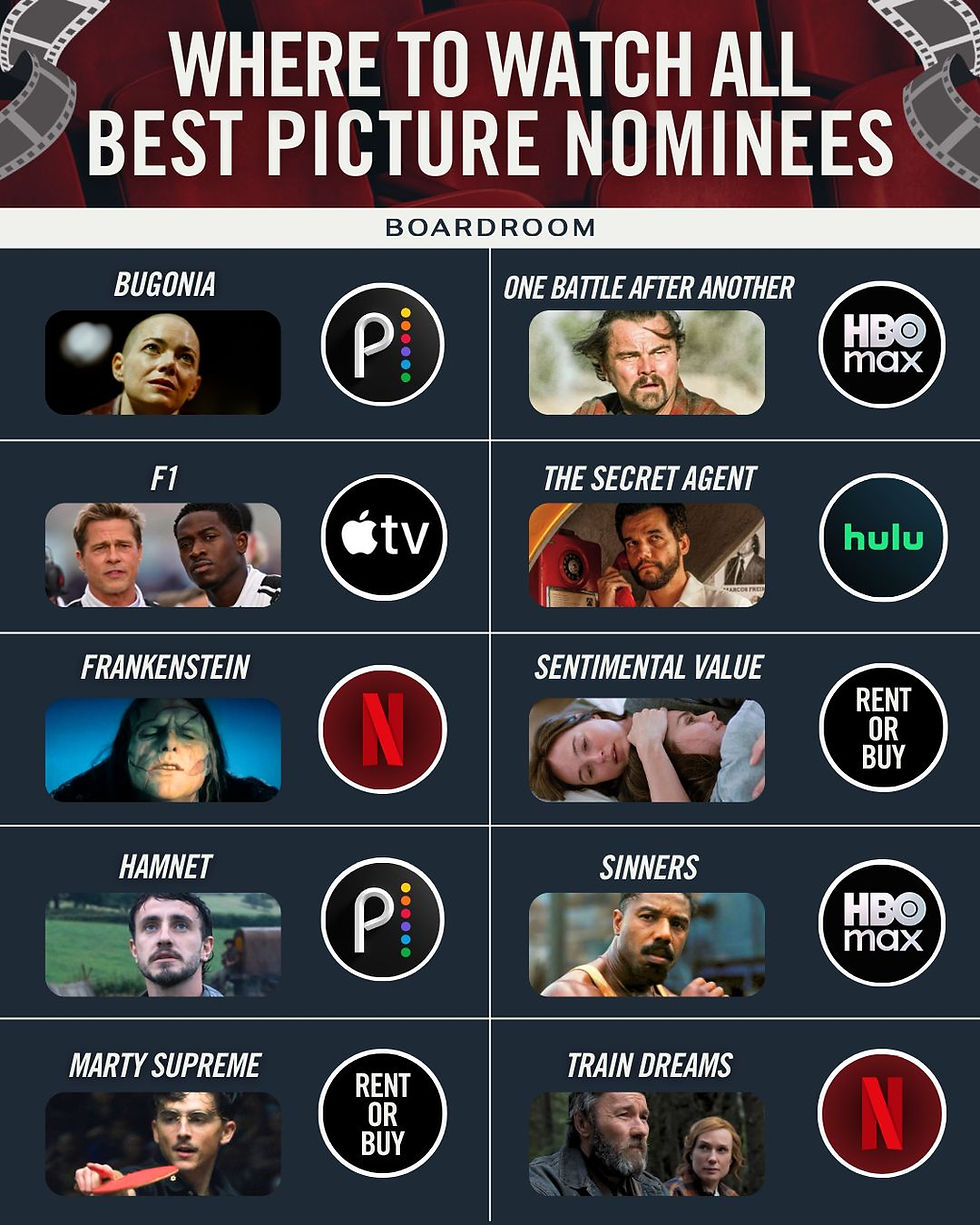
BEST PICTURE STREAMING OPTIONS
In spite of my staunch belief that movies are best seen in a theater, here are the streamig venues for the 2026 Best Picture nominees for those who can't/won't/don't go to a theater.
Happy Movie-ing!


Liked and shared.