

REVIEW. MICHAEL: Jaafar Jackson shines in a glossy fairy tale biopic that doesn't quite find Neverland.

Updated: Apr 26
He loved Peter Pan. And Mickey Mouse. He reveled in the athletic aristry of Gene Kelly and the effortless elegance of Fred Astaire. The Three Stooges made him giggle, and he admired the multi-hyphenate (writer/actor/director/producer/composer) genius that was Charlie Chaplin. He had a profound compassion for human suffering (perhaps related to the abuse he endured at the hands of his father Joseph), and a genuine desire to do good.
All of these influences and attributes are emphasized in Antoine Fuqua's (Training Day) new biopic, Michael, which tells the story of Michael Jackson's rise to fame, from performing at local venues near his Gary, IN birthplace in the late 1960s to commanding stadium-filled concerts before he turned thirty. These moments - of Jackson's desire to find human connection amidst a life that made him into something of a circus monkey (his affection for his adopted chimp Bubbles is no surprise) - give the film a touching, if unsatisfying, sense into what made Jackson tick.
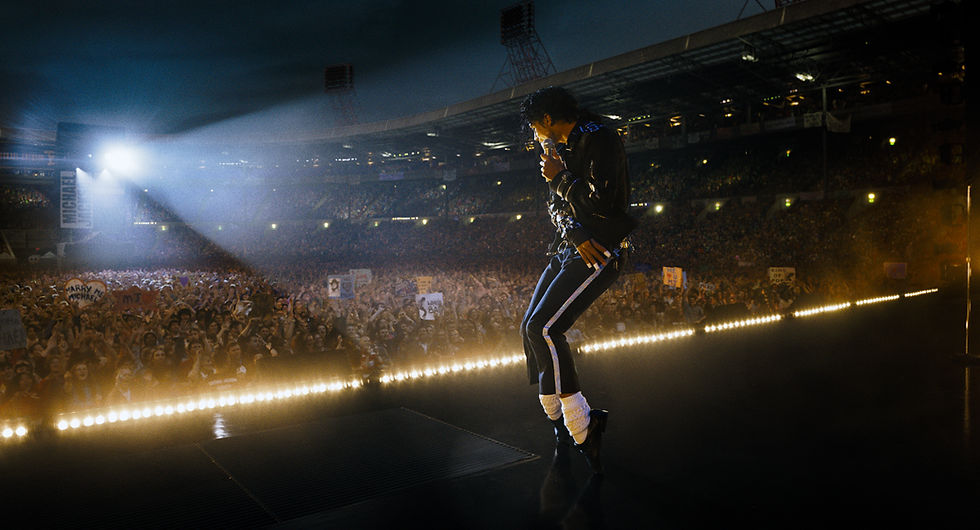
But that's about all we get - a glimpse and not much else. Michael offers up a glossy, fan-friendly tale of the singer's formative years as a member of the Jackson 5 and his subsequent battle to separate from the family and embark on a solo career. In fact, by the time Jackson launched the 1988 Bad Tour which bookends the narrative, he was already an established star in his own right. So, when the movie began big and splashy with the orchestral strains to "Wanna Be Startin' Somethin'" with the camera following Jackson from behind as he awaits his entrance to the Bad concerts at Wembley Stadium in London (July 1988), I couldn't help but think, here we go again.
Close your eyes. Cue the music. Imagine Eddie Van Halen's lengendary guitar solo to 1982's "Beat It" playing in your head. Picture Michael Jackson (MJ) in that red leather jacket, black stovepipe pants, white socks and loafers, snapping his fingers as urban gang members dance around him in the coolest mock-fight choreo ever.
Come to think of it, keep your eyes closed and, if you're like me, remember the real Michael Jackson first introducing the moonwalk on TV's Motown 25: Yesterday, Today, Forever special in 1983. Forty-three years later, that original moment remains as spectacular as the night forty-seven million viewers watched MJ's ground-breaking performance. It ranks right up there with Elvis's first hip-swiveling appearance on The Ed Sullivan Show in 1956.
Michael Jackson was my Elvis. Though I clearly knew who Elvis was as a kid, his career had already peaked by the time I really paid attention to his music. Famously recognized as a "white man who sounded black," Elvis probably did more to break down racial and cultural barriers than any piece of legislation passed before and during that time. MJ was kind of the flip side of Presley, a black man who sounded white, whose music transcended social and econonic divides. Jackson's music underscored so many important moments in my childhood and early adult life that it was difficult for me to watch Michael without revisiting those emotional connections. As soon as I heard the first few notes to "I'll Be There," I could feel the tears welling up... and I was back in middle school feeling the first pangs of unrequited love.
But that was then. This is now, and - for reasons I still can't wrap my head around other than a money grab - we're in the midst of a rock star biopic frenzy. Blame it on the boogie... or at least on Milos Forman, whose 1984 film adaptation of Peter Schaffer's successful 1979 stage play, Amadeus, created the template for the modern rock drama. Since then, there have been over a dozen major film releases about pop/rock artists (and various other musical genre stars), from 1986's Sid and Nancy (Sid Vicious of the Sex Pistols), to 2004's Ray (Ray Charles in an Oscar-winning turn for actor/comedian Jamie Foxx), and 2018's Bohemian Rhapsody (another Oscar-winning performance from Rami Malek as Queen frontman Freddie Mercury).
More recently, we've had Rocketman (Taron Edgerton as Elton John), Elvis (another Oscar nom for Austin Butler as the King of Rock 'n' Roll), A Complete Unknown (a brilliant Timothée Chalamet as Bob Dylan in a performance that should have won an Oscar), Back to Black (does anyone remember this forgettable tale of singer Amy Winehouse?), and Deliver Me From Nowhere (a highly touted, if equally disappointing take on Bruce Springsteen's emotional struggles that led to his writing of the Nebraska album).
As if we don't have enough documentation through recordings, music videos and concert films, filmmakers seem intent on one-upping each other with the next best interpretation of a musical icon. It's almost becoming an actor's pathway to an Oscar nomination. And there are more movies coming with reports that Jon Bon Jovi and Madonna both have biopics in the works (Madonna is apparently directing as well), plus Sam Mendes's four-movie epic about The Beatles (one film per band member), scheduled for a spring 2028 release. Will binge-watching in a movie theater become the next pop culture trend? Enough already!
For now, it's Michael, director Antoine Fuqua's (Training Day) benign tale of Michael Jackson's early years: from the Jackson 5's creation in 1966 until Jackson's final break with his brothers at the start of the Bad Tour in1988. It is not a movie version of 2021's Broadway jukebox production, MJ: The Musical, which focused on Jackson's rehearsal for the Dangerous Tour in 1992, using flashbacks to reveal some of his childhood trauma, including paternal abuse, as well as the beginning of more complex adult insecurities. Like some other biopics, notably the aforementioned A Complete Unknown and Deliver Me From Nowhere, Michael centers on a very specific 20-year period in Jackson's life: it ends long before the allegations of child abuse against Jackson that occurred in the early 2000s. If you're looking for a gritty expose of MJ's sexual behavior, or an insightful probe into his psyche, you won't find it here.
Fuqua's movie - co-executive produced by several members of Jackson's family - is really a love letter to Michael: his unquestionable talent, his resillience in the face of constant media scrutiny and personal adversity (besides the physical/emotional abuse from his father, he experienced a near death disaster involving a pyrotechnic mishap while filming a Pepsi commercial in 1984), and his enduring legacy as one of pop music's most important artists.
The film's accuracy depends on whose viewpoint you're inclined to accept. There are already several articles online pointing out varous factual distortions and omissions. The costumes and concert re-enactments are, arguably, the most authentic replications along with the original recordings. Though Jackson himself has described his father's cruel mistreatment when he was a child and his subsequent determination to control Michael's career, MJ's brothers have more recently disavowed any notion that their father was abusive. The movie only shows one incident of Joseph hitting Michael with a belt. The rest is mostly bravado, threats and simmering anger. Truth or a convenient collapsing of the Jackson family's home environment?
Other family members (specifically sisters Janet and Rebbie, who have been critical of the movie's content), are noticeably absent from the story, as are his much publicized personal relationships with the actresses Tatum O'Neal, Stephanie Mills and Brooke Shields, which would have happened during this time. Only older sister LaToya (one of the film's executive producers) is shown being part of the family dynamic (and a quiet cheerleader for MJ).
Even Quincy Jones (Kendrick Sampson), whose brilliant collaboration with Jackson on the Off the Wall and Thriller albums is now the stuff of pop music folklore, is relegated to a few recording studio scenes. More attention is given to Berry Gordy (Larenz Tate), Motown's President who takes a warm and fatherly liking to young Michael (Juliano Krue Valdi). Their scenes together are sweet and potentially meaningful, but all too brief.
Later, as Michael plans to disconnect professionally from the Jackson family brand, John Branca (Miles Teller) becomes MJ's self-appointed lawyer/manger providing the entertainment-savvy representation MJ needs. Again, their scenes are sharp and focused, but all too few. Finally, in a touchingly paternalistic/protector role, Bill Bray (KeiLynn Durrell Jones) who was Michael's personal bodyguard, creates a kind of emotional lifeline for MJ as he matures as an artist and adult. The scenes between Bill and MJ are the only ones, besides those with his mother Katherine (a very affecting Nia Long), that suggest any kind of deep personal connection. Bray knows (and loves) Michael as well, if not better, than members of his own family.
From Fuqua's storytelling, it's clear MJ had several father figures besides Joseph, but their importance to his personal and professional growth is never really explored beyond a passing comment or a fleeting episode. Similarly, there have been many stories about MJ's obsession with childhood books and toys, from Peter Pan to Mickey Mouse. All are on display here, mostly as props. No further insights are suggested, though there seems to be an assumption that viewers would make their own connections. At any rate, you can literally predict the outcome of each scene, even if you don't know Jackson's life story, so any additional takeaways are minimal.
The unfortunate assignment of playing the angry, abusive Joseph Jackson falls to the always exceptional Colman Domingo who, like Miles Teller's John Branca, are buried under some of the worst rubberized prosthetics since Tom Hanks portrayed Colonel Tom Parker in Baz Luhrmann's Elvis (2022). Ditto Mike Myers, whose almost comedic cameo as CBS Records President Walter Yetnikoff addresses one of Jackson's (and the movie's) more serious challenges: getting airplay on MTV, which was notoriously unfriendly to black artists in the early 1980s. It was Jackson (and later Prince) who became fixtures on MTV's video playlist, but not before Yetnikoff threatened to pull all other CBS artists (including Springsteen and Dylan) from the cable network unless Jackson's "Billie Jean" was immediately added to its rotation.
Whether the scene was a an accurate representation of what happened or (more likely) a condensed dramatization, is irrelevant, given the movie's overall avoidance of delving into any substantive issues with any depth. Still, it would have been interesting to see more development of what made Jackson the curious musical savant he became. Since I remember almost all of the events depicted here, including where I was and how it felt watching "Thriller" (the first extended music video that premiered on MTV in December 1983), a more detailed backstory would have enriched the already positive flasback that was playing in my head.
Which brings us to what was surely an overwhelming task for Jaafar Jackson: playing, without immitation or mimicry, his legendary uncle, Michael Jackson. Jaafar is the son of Michael's older brother (and Jackson 5 member) Jermaine. It's as daunting a task as playing Elvis, for sure, as both artists are deeply embedded in our cultural database. Jaafar has mastered his uncle's moves, including the famed moonwalk, to perfection, and it is here especially that Fuqua successfully uses quick cutaways and tight editing to encapsulate the beauty and finesse of MJ's smooth R&B boogie style, turning it into something cool, timeless and sexy, a rhythmic dynamic that defined a generation. The script really doesn't require Jaafar to demonstrate much in the way of range or emotional complexity, and he does a commendable job of evoking MJ's charm: his smile, his charisma and, most of all, his vulnerability.
In this respect, it was probably better than Fuqua opted to keep Jackson's original vocals and recordings in tact, with Jaafar lip-syncing to MJ's songs, rather than have him (or anyone else) try to replicate MJ's unique singing voice. Jaafar convincingly captures MJ's speaking voice and cadence and, if you close your eyes (again), you can sense Michael's presence. So there's good stuff here, but not much nuance or subtlety. I felt transported back to the early 1970s reading my old Tiger Beat magazines, thinking this is how MJ's life would have been depicted, and this is what the adolescent me would have liked. Fuqua is not trying to reveal new insights into MJ's life or music and, from the reaction of the audience at the pre-release date matinee I attended, he didn't need to. People came to see Michael Jackson or any reasonable facsimile, to watch his life portrayed in simple, uncomplicated fashion.
Most of all, they came to hear his music, and the movie plays like an feature length MTV video, complete with an almost continuous soundtrack that seamlessly blends one Jackson hit into the next.
When the movie faded to black - with a suspicious tagline that "his story continues" - I couldn't help but smell "sequel" in the making. We shall see, as the next chapters in Jackson's life are not as easily gentrified. But as the credits rolled, no one left the theater, which was astronishing in its own way, as the credits rivaled those of 1982's Gandhi in terms of length and number of names. No matter. They were jammin' to MJ's "Don't Stop 'Til You Get Enough."
I left the theater to the beat of Jackson's hit feeling lighter in step, but also a bit wistful realizing (again) that another part of my youth is gone. The Jackson 5, along with the Osmonds, the fabricated-for-TV Partridge Family and The Monkees, all formed my musical pre-teen sensibilities until I went to college and discovered all the counterculture artists that were a generation older. Springsteen was my Dylan, U2 were my Beatles, and Michael, well he and I share the same initials, so he will always be my "other" MJ: the brilliant star in pop music's universe who changed how we hear and see music, who struggled with personal demons, who left us far too soon.
It also got me thinking (again) about our fascination with celebrities, about participating in a kind of voyeuristic, if faux, peek into their private lives. Did I learn anything new about Michael Jackson after watching Michael? Not really, but I'm a pop culture geek, so maybe I'm not the best barometer of what a more casual viewer would like. I would argue, though, that Baz Luhrmann's recent documentary EPiC, which uses actual concert and interview footage of Elvis Presley during his seven-year, 636 sold-out concert Las Vegas residency, offers more insight into Elvis's life and heart than any movie or TV dramatization of his life. Neither fully a documentary nor a concert film, EPiC is something Luhrmann described to Deadline magazine as "something new in the Elvis canon... that befits the magnitude of Elvis as a performer but also offers deeper revelations of his humanity and inner life."
There might be a parallel opportunity with Jackson's life using This Is It, a 2009 documentary released several months after Jackson's death, that chronicled his preparation for what would have been an eight-month concert residency at the O2 in London. Footage, which included behind-the-scenes dancer/singer auditions and rehearsals, had not been intended for release until Jackson's sudden death in June of that year, after which choreographer Kenny Ortega (and others) agreed that the "greatest concert never seen" needed to be shared with the world. Another money grab?
The movie was given a limited two-week theatrical release in October 2009 and received generally positive critical reception and substantial box office receipts. Film critic Roger Ebert called it "extraordinary" and the Rolling Stone's Peter Travers concluded it was a "transcendent tribute" to Jackson, given that it didn't have - or need - a safety net. I saw that film in a theater all those years ago, and I still recall that, like EPiC, I felt a bit closer to Michael as, through his own words and rehearsal moments, he unintentionally revealed something about his style, his vision and his heart.
Too bad Fuqua didn't utilize the same abandonment here. Instead, he's created too many "nets," boxing himself into what appears to be an attempt to preserve MJ's legacy as a series of rags-to-riches scenarios. You know, poor black kid from the midwest makes good. If Fuqua had taken more risks developing MJ's budding musical autonomy, or the childhood demons that likely haunted him his whole life, we might have a more provocative (even insightful) exploration of fame, family ties, and the complexities of genius. In its place, we get an amiable, unnecessarily slick, cinematic biography of one of the 20th century's greatest musical legends.
In what for me was the movie's best quote, the one that almost captured MJ's quest for success and immortality, Michael articulates his relentless work ethic to Quincy Jones who has just called his talent a "blessing from God" and has suggested that he take a vacation before recording what would become the Thriller album (still the best-selling album of all time). MJ responds, "You don’t understand — if I’m not there [working] to receive these ideas, God might give them to Prince.”
The audience responded with laughter. In real life, though, Jackson actually made this comment to choreographer Ortega when preparing for the O2 concerts shortly before his death in 2009. Ortega had recommended MJ take a break before resuming the intense rehearsal schedule, but Jackson was adamant to press on. The historian in me is cringing a bit that such an important statement was misused, creating an inaccurate perception of how MJ saw himself and his competition within the pop/rock world at that time. In 1980, Prince was not yet an established star, but by 2009, both were competing more directly (and after various personal scandals and setbacks) for a similar audience demographic.
It's little things like that misplaced quote - important though it is - that makes writing reviews like this one challenging. Sometimes the most difficult reviews for me are those where I can easily point out a movie's flaws, shortcomings, and weaknesses, but not necessarily conclude that the film isn't worth seeing. That's partly why I'm conflicted here. I know Michael is little more than a slick biopic cobbled together for the millions of Michael fans who want one more chance to experience his music. MJ's eccentricities are well-known, but here remain as enigmatic as The King of Pop himself.
So many questions remain about his childhood (of lack thereof), his sexual behavior, his musical genius. Of all these, it's only the last one that Fuqua chooses to highlight, mostly through extended sequences of Michael making recordings and constructing performances. The scene in which he asks director Jon Landau for one more take during the "Thriller" shoot is a clear example of his musicality: his vision of what a performance should look like and his determined perfection to get exactly what he wants. That in itself is worth further examination and articulation, but Fuqua's final cut - reportedly plagued by numerous setbacks and script changes during filming - is a meticulously scrubbed celebration of MJ's struggle for autonomy and creative freedom.
Critics will surely have at this film. Spencer Kornhaber's review in The Atlantic screamed "It's Bad" (it's not), and Alissa Wilkinson concluded that, like Joseph Jackson, all the movie gives us is a perfect child capable of delivering great performances. Fair enough, but there was something else that keeps nagging at me about the movie. Despite being surrounded as an adult by all the childhood playthings (games, toys, animals) he loved most, MJ didn't seem happy. I couldn't ignore the lingering sadness that is conveyed in Jaafar Jackson's eyes. Behind the smile, the fake bravado, and the confidence in his own genius, Michael Jackson was alone in his success and no amount of money, possessions, or family support could take away that emptiness. And even Antoine Fuqua's carefully crafted narrative can't completely erase the harsh reality of a childhood lost and an adulthood never full realized.
That said, perrhaps Michael will be a first step toward understanding the fable that is/was Jackson's extraordinary life. If future film installments materialize, it would be fascinating to probe his idiosyncracies and his genius more deeply. So maybe we shouldn't stop until we get enough... Intel on MJ, that is. Because only then can we hope to find his Neverland.
*******
Michael is currently playing in theaters. It is rated PG-13 for "thematic material, language and smoking." Lots of smoking. But I don't get it. All these rock star biopics rated PG. Anyone who's ever spent five minutes around the music business (my time circling its orbit is slightly longer) knows that the recording industry is cutthroat, and any depiction of it would not yield a PG rating. Geez...


Comments