

REVIEW. THE DEVIL WEARS PRADA 2: Satan's Fashionably Late Sequel is Wickedly Fierce and Fun, But More Prêt-à-Porter Than Haute Couture.

Updated: May 1
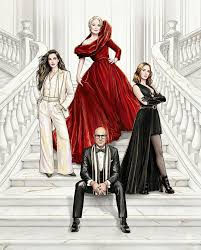
Coco Chanel once famously gave this advice about fashion: "Before you leave the house, you should look in the mirror and remove one item." A minimalist approach to dressing? Maybe, but there's more here than just a flip trick to assess what you are wearing. Chanel's comment suggests something more: taking a moment for self-reflection to refine how you look, to present yourself in the best way possible, to think about who you are as much as about what you have on.
Hold that thought because it's time again to gird your loins and strike a pose.
Twenty-first century fashionistas are coming.
Did I miss anything?
Unless you've been living under a rock for the past month (I actually know someone who has...sort of...consumed with final book edits, but that's a separate universe), it would have been almost impossible to miss the hard core press tour that launched in late March for director David Frankel's Long-awaited, much-anticipated, designer-driven sequel, The Devil Wears Prada 2. An extension of the ground-breaking 2006 film, which, in turn, was based on Lauren Weisberger's best-selling 2003 roman à clef of the same name, The Devil Welars Prada 2 revisits New York city's high-powered fashion world (and the journalists who follow it), twenty years after its predecessor.
If you were one of the dozen people or so who haven't read or seen the originals, here's a quick recap: The Devil Wears Prada follows one Andrea "Andy" Sachs (Anne Hathaway), a recent college grad in pursuit of a respectable career in journalism who instead finds herself working as the second assistant to ficitious fashion magazine Runway's tyrannical editor, Miranda Priestly (Meryl Streep). At first scorned and shunned for her lack of fashion savvy, Andy becomes Miranda's most efficient and reliable assistant, accompanying her to Paris Fashion Week before realizing that the formidable, cutthroat world of haute couture doesn't exactly fit with her own sense of professional integrity. So she leaves the job that "a million girls would kill for" to pursue her own journalistic dreams.
The Devil Wears Prada's (the book and movie) obvious comparisons to real-life fashion bible Vogue and its equally messianic editor-in-chief, Anna Wintour, is the stuff of which Hollywood movies (and models) are made. Both Weisberger's novel and the original movie proved to be catnip for celebrity-hungry fans looking to get the dish on the rich and famous. But then the movie unintentionally offered something more.
What on paper looked like another fairly typical rom-com turned into a huge box office hit, capturing a massive global audience, elevating it beyond the usual "chick flick" tag, crossing movie genres, sexual conventions and audience demographics to become a cultural phenomenon. Streep's turn as the stone-cold prototype for horrible bosses nabbed her several awards, including the Golden Globe for Best Actress in a Musical/Comedy, plus an Oscar nomination. The movie itself was honored by numerous film critics' societies, and was named one of the American Film Institute's (AFI) best movies of 2006.
With all Prada's critical and financial success, a sequel seemed inevitable, but nothing appropriate immediately materialized, including Weisberger's 2013 follow-up novel, Revenge Wears Prada. Streep and Hathaway each won Oscars for subsequent films: Streep won her third Oscar in 2012 for Best Actress in The Iron Lady; Hathaway won the following year as Supporting Actress in Les Miserables. Co-stars Stanley Tucci continued to expand his career, and Emily Blunt went on to establish hers with various nominations and accolades. Both Tucci and Blunt have received Oscar nominations for other films, and Tucci has recently emerged as a bit of a gastronome with his epicurean series, Searching for Italy.
So why a sequel now? Hollywood sequels usually arrive quick on the heals of their box office winners, so to capitalize on potential franchise bankability. No one waits twenty years for a sequel, and certainly not the movie industry. Why the exception here?
A lot has to do with timing, finding a good script and, more importantly, getting Streep and Hathaway on board with a substantive story. Re-enter Aline Brosh McKenna, who wrote the first screenplay, with a premise that addresses some of the changes and challenges facing journalism today, specifically, how print media has become endangered during the past two decades. The Devil Wears Prada was released in June 2006, almost exactly one year year before the iPhone was launched. The impact of technology and social media on a world once reliant on print copies and home delivery subscriptions cannot be underestimated, and serves as the springboard issue in the sequel.
When we are re-introduced to Andy, she has become the successful journalist she aspired to be and works at a magazine called Vanguard. We first see her seated at an awards luncheon where she is a nominee for the top prize. Then, just before her name is announced as a recipient of journalism excellence, she receives a group text informing her that the magazine is folding and she and several colleagues have been terminated. Shaken by the news, Andy's acceptance speech becomes a rant for the important of journalistic integrity and leads her to a return at Runway, where former boss Miranda still reigns, though now navigating a bit more precariously amidst the world of online subscriptions and social media posts. Miranda has been targeted for partnering with a company that is exposed for harboring sweatshops, a story that catches fire online and threatens both the future of Runway magazine and Miranda's career capstone and legacy.
Andy misinterprets her invitation to return to Runway as an olive branch from Miranda. tt is really Miranda's longtime creative director Nigel Kipling (Stanley Tucci), once Andy's mentor, who (we later learn) brokered the reunion. The setup isn't subtle: former assistant, now a respected journalist, returns to save estranged boss and magazine from scandal and extinction. Various plot twists and obstacles ensue, including an encounter (natch) with Andy's old Runway colleague and rival, Emily Charlton (Emily Blunt), a viciously ascerbic fashion snob now a senior executive at Dior.
Andy's mission - to save Runway and Miranda's job (and maybe gain some personal validation along the way?) - is no small task, and the movie smoothly takes us from corporate meetings to designer fittings with ease, carefully using quick cut edits that combine MTV-inspired clips with pulsating rhythms. There's barely a moment when a strong backbeat isn't looming, ready to break into another montage of fashionista moments. From the get-go, Prada 2 announces its presence with more noise and bravado in the first five minutes than the HBO series Sex and the City's cinematic reappearance in 2008, and sustains that pulse for the next two hours. I couldn't help but wonder if the same crew that edited Fergie's slick, musically buoyed NYC paean "Label or Love" that launched SATC also influenced Prada 2, here with Lady Gaga's (newly composed for the movie) "Runway" providing the heartbeat to its opening credits.
Gaga (credited as Stephani Germanotta, her birth name) wrote three songs for Prada 2: "Runway," "Shape of a Woman," and "Glamorous Life," any of which could nab an Oscar nomination. I'm calling it now: expect to see Gaga on the short list come next year's Oscars for Best Original Song. She also has a brief, but pivotal cameo in the film, one that helps link Miranda's dilemma and the final resolution together. Her performance not only lights up the screen, but may be the only thing in the movie as stunning as Meryl.
The other cameos - over thirty names are credited at the end! - are mostly throwaways, primarily serving as arm candy-esque decorations to various parties and gatherings. A few, like designer Donatella Versace and musician Jon Baptise, utter a few words, but nothing of real value added, except to reinforce the celebrity-rich world Miranda inhabits. We get it, and so apparenty did director Frankel, who makes sure to maximize the number of recognizable faces for the Boomer/Millennial audience the movie targets.
There are a few new characters, including Kenneth Branagh as Stuart, Miranda's newst husband, a concert violinist who does little more than fetch for her at home and offer words of support about her impending demise at Runway. I like Branagh a lot, but I'm not sure what he's doing here or why McKenna and Frankel felt it necessary to include him as his character doesn't serve much of a purpose. Ditto Patrick Brammall, who plays Peter, an architect Andy meets while apartment hunting and who serves as a kind of love interest (though we really don't see much in terms of their relationship). Again, fine actor without much to do other than be a sounding board for Andy in a few brief scenes. Seems those conversations could have been handled differently. It's not like either male added much to the story or to Andy or Miranda's characters.
Filling in for real-life philanthropist Mackenzie Scott (ex-wife of Amazon founder Jeff Bezos) is the fictional Sasha Barnes (Lucy Liu), ex-wife of an idiot techno-billionaire named Benji (Justin Theroux), whose goal is to give away her fortune. Sound familiar? Unlike Mackenzie, though, who has donated billions to Historically Black Colleges and Universities (HBCU's) and other institutions dedicated to helping underserved populations, Sasha is solicited to help Runway's failing sales. I'll leave it at that and hope that I've said everything about under-represented populations correctly.
Embracing political correctness is a problem for Miranda, who has seen workplace mores, language and behavior change dramatically since 2006. No longer can she enter the office and throw her coat at her assistant to hang it up. Her insults have been muted, almost neutered, so the usual barbs we've come to expect are more calculated and, in some ways, more effective, as their content and delivery suggest a more layered, smoldering disdain on Miranda's part toward the industry and the individuals that helped establish her career. In one amusing segment, we watch Miranda struggle to hang her coat on hanger and attach to a closet hook just beyond her reach.
In another, at a staff meeting, during one of the movie's funniest exchanges (and maybe my personal favorite), Miranda expresses her dissatisfaction to a videographer who is sharing his new promotional ad for Runway: "They (the models) look like they're circling a methodone clinic in New Jersey," she hisses. Miranda's first assistant, Amari Mari (an appropriately haughty Simone Ashley, from the Netflix series, Bridgerton), immediately wags a finger at Miranda, and makes a frowning face. "I know it's inappropriate," Miranda replies. Then, leaning in with deadpan seriounsness, she looks straight at Amari and asks, "But...is it the meth clinic? New Jersey?"
Bam. Vintage Miranda and classic Meryl all rolled into one. In this brief moment, she captures changing social norms and Miranda's struggle to embrace these new expectations and still do her job effectively. Later in the movie, she encourages Andy to wrote her (Andy's) proposed biography of Miranda "warts and all," saying that people must understand that all positions of perceived power and authority come at a price.
Indeed. Unfortunately, there isn't a lot of such wisdom expressed in The Devil Wears Prada 2, though it remains a very entertaining, well-crafted, smoothly acted film. Hathaway, Tucci and Blunt are all on point, setting off a reunion of sorts for fans of the original with their beloved cast. Commentary on social media, including fear of AI and the declining interest in subscribers to actually read something is maintained throughout the movie, but without much depth or development. When Miranda finally confronts nemisis Emily, who has underhandedly been trying to push Miranda out of Runway and assume her job, she offers Emily this cutting remark about their inherent differences: "You're not a visionary. You're a vendor." Ouch.
The notion of fashion as art is a noble one, and the movie keeps emphasizing the need to hold on to some of the creative traditions that make us human, but it never quite seals the deal effectively. I left the theater a bit disappointed at the all too neatly tied up ending, one that doesn't offer much proof that Andy or Miranda will continue to make a difference on behalf of good journalism. For all its talk about how social media is slowly erasing good writing, there was much hope for the printed word or the human touch.
So what makes Prada 2 worth the price of admission?
For my money, the best thing about Prada 2 is Meryl Streep who, for the past fifty (Yikes!) years, is the finest actor who ever set foot on a stage or graced the silver screen. Period. No discussion. No other artist has her range, depth, or collection of diverse, eclectic, or successful performances. Even if the movie was less than fabulous (re: 1986's Heartburn), Meryl was superb. I'd love to see her get a second nomination for this role, as she has brilliantly taken what could be a throwaway caricature and turned it into a character with layer upon layer of nuanced humanity.
Consider what she's done. Streep fashioned Miranda Priestly not after Anna Wintour as many assumed, but after Mike Nichols and Clint Eastwood, two directors whose quiet leadership on film sets was both inspiring and intimidating. In a recent interview, Streep said she had no interest in trying to mimic Wintour, but rather to understand what made an individual like that successful. In her own work, Streep found that Nichols had a "sly sense of humor" which he used to coax and challenge actors. Eastwood, on the other hand, "never screams" and commands a movie set with a kind of quiet respect that creates a commanding, calm presence. Her Miranda never raises her voice, barely speaks above a low-toned whisper, but clearly knows what she wants and how to get things done.
If you've ever had a horrible boss (I've had several over the years), Miranda may appear as an unreasonable tyrant...except that she gets results and she clearly understands (and manipulates) human nature. None of my terrible supervisors were as smart or witty as Miranda. They were generally toxic narcissists on deviant power trips that rarely yielded success, but they usually drove talented staff to seek employment elsewhere. Miranda may be self-focused, but she also has the intelligence and the latitude to get creative projects done, which is why she is so demanding of her staff. Her longtime relationship with Tucci's Nigel is lovely to watch, not only for the two veteran actors doing what they do best, but by bringing out the genuinely platonic love and the deeply abiding trust that Nigel and Miranda have for each other.
If we must put a label on it, The Devil Wears Prada 2 is a sharp, fast-paced, witty and, at times, scathing look at what technology had wrought on humans, through the lens of fashion. It is mostly entertaining, but not completely devoid of thought and meaning. What it lacks in depth, it makes up for in keen, astute performances from the four lead actors.
And that's also the biggest problem with this sequel. With all the fine performances, slick editing and hip clothing, Prada 2 suffers from trying to stuff too much into an already strong story, one that would have benefitted from more character development and fewer empty cameos and fashion montages. The result instead is kind of like wearing Birkenstocks with an Armani suit: poorly or overaccessorized fashion simply defeats the purpose. It's going to TJ Maxx looking for Versace and coming home with a Banana Republic sweater. Nice, but definitely not haute couture.
I still use Coco Chanel's method of checking how I look before going out just because it gives me that last opportunity to have a moment with myself, to make sure I'm comfortable with how I present myself to the world. Too bad director Frankel did not utilize that practice here. If he had, The Devil Wears Prada. 2 might have been more than just very entertaining, better than the average movie diversion. It might have been something really special.
That's all.
*******
The Devil Wears Prada 2 is currently in theaters. It is rated PG-13 for "strong language and some suggestive references." Yeah, any mention of bras and other unmentionable clothing is clearly risqué and not for tender ears. Eventually, Prada 2 will stream exclusively on Disney+ and Hulu... but not for awhile as box office expectations are huge.


Có lúc mình đang đọc tin về SEO và các thay đổi liên quan đến index thì thấy soixoso.net xuất hiện trong danh sách mình đang xem. Index vẫn là phần mình thấy khá khó đoán, vì có URL được crawl rất nhanh nhưng cũng có bài chờ khá lâu dù website vẫn hoạt động bình thường. Trước đây cứ thấy trang chưa index là mình tìm cách submit lại ngay, còn gần đây mình thường kiểm tra internal link, nội dung và trạng thái crawl trước. Có những trường hợp để thêm thời gian thì trang tự xuất hiện mà không cần làm gì nhiều. Vì thế mình đang cố phân biệt vấn đề kỹ thuật thực sự với những…